
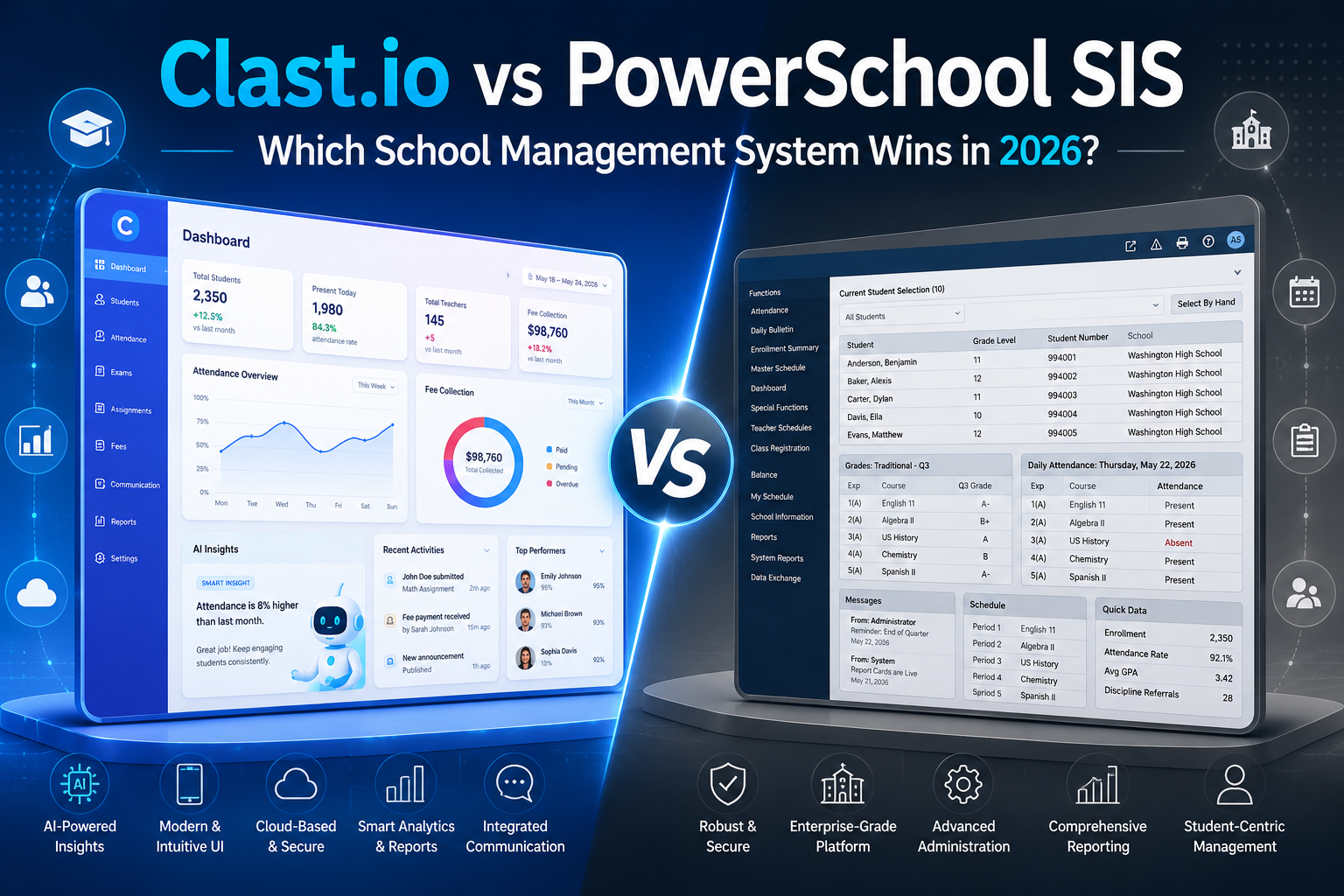
Choosing a student information system is a five-to-ten-year commitment. Migrate data once, train your staff once, and you generally live with the result until something breaks badly enough to force a switch. That's exactly why "Clast.io vs PowerSchool SIS" is one of the highest-stakes searches an administrator can type into Google this year.
Both platforms manage the same core job attendance, grading, enrollment, communication, reporting but they were built for different institutions, at different points in software history, for different budgets. This guide breaks down where each one actually wins, where marketing pages oversell, and which type of school should pick which platform.
Quick answer: PowerSchool SIS is the stronger fit for large K-12 public school districts in the US and Canada that need deep state-compliance reporting and can support a multi-month implementation. Clast.io is the stronger fit for private schools, academies, colleges, and universities anywhere in the world that want a modern, AI-assisted, all-in-one platform (SIS + LMS + ERP) without enterprise pricing or a six-month rollout.
What Is PowerSchool SIS?
PowerSchool SIS is a student information system built primarily for K-12 public school districts. It has been a category leader for over two decades and is one of the most widely deployed SIS platforms in North America. Districts use it to manage enrollment, scheduling, attendance, gradebook (via PowerTeacher Pro), state and provincial compliance reporting, and parent/student access through a companion portal and mobile app.
Where PowerSchool SIS is strong:
- Compliance depth. Its reporting engine is purpose-built to keep up with state and provincial funding and compliance rules, which matters enormously to public districts.
- Configurability. Districts can build custom fields, pages, and reports without vendor involvement, and pre-built reports cover most common needs.
- Ecosystem maturity. A 20+ year install base means abundant online forums, user groups, training events, and third-party integrations, including its own Schoology LMS.
- Flexible hosting. Cloud-hosted and self-hosted deployment options exist, which some IT departments prefer for data control.
Where it tends to fall short, based on independent buyer reviews:
- Steep learning curve and pricey training. Reviewers on Software Advice and TrustRadius repeatedly cite the training courses as expensive and the interface as unintuitive for new staff.
- Sales-led, opaque pricing. PowerSchool SIS does not publish self-serve pricing; every quote goes through a sales team, and the platform scores poorly on transparent, agent-buyable pricing.
- Cost scales up fast. PowerSchool has grown through acquisitions and add-on modules, and multiple reviewers note the platform can price itself out of reach for small and mid-sized districts.
- Rollout time. Implementation for large districts commonly runs three to six months, with real investment required in staff training.
- UX friction in daily workflows. Teachers frequently mention gradebook quirks no fill-down for repeated scores, no tab-between-columns, confusing absence symbols as ongoing annoyances rather than dealbreakers, according to user reviews on G2.
In short: PowerSchool SIS is a proven, powerful, compliance-first system. The tradeoff is complexity, cost, and a platform genuinely built around the US/Canada K-12 public-district use case.
What Is Clast.io?
Clast.io is a newer, AI-powered, all-in-one operating system for schools, academies, colleges, and universities. Instead of positioning itself as "just an SIS," Clast.io combines Student Information System, Learning Management System, and ERP functionality admissions, academics, attendance, gradebook, HR, payroll, finance, library, task management, and role-based communication into a single platform with pre-built dashboards for every institutional role, from Super Admin to Parent.
Where Clast.io is strong:
- True all-in-one scope. Where PowerSchool SIS handles the student-record core and leans on partners like Schoology for LMS functionality, Clast.io bundles academic delivery, admissions, HR/payroll, finance, library management, and communication into one system with one login and one data model.
- AI built in, not bolted on. AI-powered analytics and AI writing assistance are included in every plan, aimed at reducing the manual reporting and drafting work that eats up administrator time.
- Simple, transparent pricing. Every plan includes the full suite of modules no hidden add-ons, no per-module upsells with a 7-day free trial and a free-to-start tier, a stark contrast to PowerSchool's sales-quote-only model.
- Fast time-to-value. Because it's cloud-native and modular by role rather than by paid add-on, institutions can onboard without the multi-month implementation timeline typical of legacy district SIS platforms.
- Global fit. Clast.io is used by universities, learning centers, and K-12 schools across multiple countries, not just US public districts, and is explicitly built to scale from a single campus to multi-campus, multi-tenant institutions.
- Unified institutional profile. A student, staff member, or parent can hold multiple roles across the institution with one continuous profile and history useful for K-12-through-college pipelines, language institutes, and multi-branch academies.
Where Clast.io is still maturing:
- Younger ecosystem. As a newer platform, its library of third-party marketplace integrations is smaller than PowerSchool's two-decade-old partner network, though its core feature set covers the large majority of what most schools need day to day.
- Less built-out for US state-specific compliance reporting. Large US public districts with heavy state funding-report requirements should evaluate this specifically, since PowerSchool's reporting engine has been purpose-built for that regulatory environment for years.
- Smaller reference base for large public districts. Clast.io's strongest, most-documented use cases so far are private schools, academies, colleges, and universities rather than large multi-thousand-student public districts.
Clast.io vs PowerSchool SIS: Head-to-Head Comparison
| Category | Clast.io | PowerSchool SIS |
|---|---|---|
| Best for | Private schools, academies, language institutes, colleges, universities — any size, any country | Large K-12 public school districts, primarily US/Canada |
| Core scope | SIS + LMS + ERP (academics, admissions, HR, finance, library, tasks, communication) in one platform | SIS-focused, with LMS via partner integration (Schoology) |
| AI features | AI analytics and AI writing assistance included in every plan | Not a core, plan-wide feature; analytics are dashboard/report-based |
| Pricing model | Transparent, self-serve plans; full feature access on every tier; free trial and free-to-start option | Sales-led custom quotes only; no published self-serve pricing |
| Implementation time | Fast, cloud-native onboarding | Typically 3–6 months for large districts |
| Role-based dashboards | Pre-built dashboards for 13+ roles (Super Admin to Parent) | Role-based portals exist but are less granular out of the box |
| Compliance reporting | Growing; not yet as deep as PowerSchool for US state-specific reporting | Purpose-built for US/Canada state and provincial compliance |
| Third-party integration ecosystem | Smaller but growing (WhatsApp, Stripe, PayPal, Google Workspace, Microsoft 365, Zoom, Teams) | Large, mature ecosystem including Schoology, Canvas, Level Data |
| Global usage | Used across multiple countries and institution types | Concentrated primarily in North American K-12 |
| Learning curve | Designed to reduce confusion via role-based access | Reviewers frequently cite a steep learning curve |
| Multi-role / multi-year profiles | One institutional profile persists across roles and years | Profile continuity across schools within a district can be inconsistent, per user reviews |
Pricing: The Real Difference
This is where the two platforms diverge most sharply.
Clast.io publishes its pricing structure directly on its site: every plan includes unlimited team members, all modules, AI-powered analytics, AI writing assistance, admissions and enrollment tools, attendance and academics, task management, finance and payments, a communication hub, reporting dashboards, priority support, and enterprise-grade data security with a 7-day free trial and no credit card required to start.
PowerSchool SIS takes the opposite approach. Its public pricing page routes every prospect to a sales contact form rather than listing tiers or per-student costs. Independent buyer reviews on TrustRadius confirm this: districts report the platform can become expensive quickly as they add modules, and multiple reviewers specifically note it becomes cost-prohibitive for districts under roughly 1,000 students.
What this means practically: if your institution wants to compare true cost-of-ownership before committing budget to a demo call, Clast.io lets you evaluate pricing and functionality immediately. With PowerSchool SIS, you'll need to go through a sales cycle before you know what you're actually paying.
Implementation and Ease of Use
Ease of use is where independent review sites are most consistent. On Capterra, Software Advice, and G2, PowerSchool SIS reviewers repeatedly flag two things: a genuinely steep learning curve for new staff, and gradebook workflow friction that persists even for experienced teachers things like the inability to fill down a repeated grade across students, no tab-key navigation between grade columns, and default percent-based grading that trips up teachers entering point-based scores.
None of these are dealbreakers on their own. But they add up to real onboarding cost, which is consistent with reviewer comments about pricey, mandatory training courses and multi-month rollout timelines for larger districts.
Clast.io's design philosophy is explicitly the opposite: pre-defined role-based dashboards mean a receptionist, a teacher, and a finance manager each see only what's relevant to their job, which is intended to cut the confusion that comes with handing every user the same complex interface. Because the platform is cloud-native and modular by role rather than gated behind paid add-ons, schools can generally get further into a working setup before committing significant budget.
Which One Should You Choose?
Choose PowerSchool SIS if:
- You run a large public K-12 district in the US or Canada with complex state/provincial compliance reporting requirements
- You have dedicated IT staff and budget for a multi-month implementation and ongoing training
- You need the reach of the largest SIS integration ecosystem, including Schoology
- Cost is secondary to depth of configurability and compliance track record
Choose Clast.io if:
- You run a private school, academy, language institute, college, or university anywhere in the world
- You want SIS, LMS, and ERP functionality in a single platform instead of stitching together multiple vendors
- You want transparent, all-inclusive pricing you can evaluate without a sales call
- You want AI-assisted analytics and communication built into your daily workflow, not sold as an add-on
- You need to onboard quickly without a multi-month rollout
- Your institution spans multiple roles, branches, or program levels and you want one continuous profile per person
conclusion
There's no universal winner here there's a better fit for your institution. PowerSchool SIS remains the safer, more proven choice for large US and Canadian public school districts that need deep compliance reporting and have the budget and IT resources for a lengthy implementation. Clast.io is the stronger choice for the much larger population of private schools, academies, language institutes, colleges, and universities worldwide that want a modern, AI-powered, all-in-one platform with transparent pricing and fast onboarding without paying for, or waiting on, enterprise-district complexity they don't need.
The fastest way to know which fits your institution is to try both: request a Clast.io demo or start a free trial to see the platform firsthand, and compare it directly against a PowerSchool SIS sales quote.