
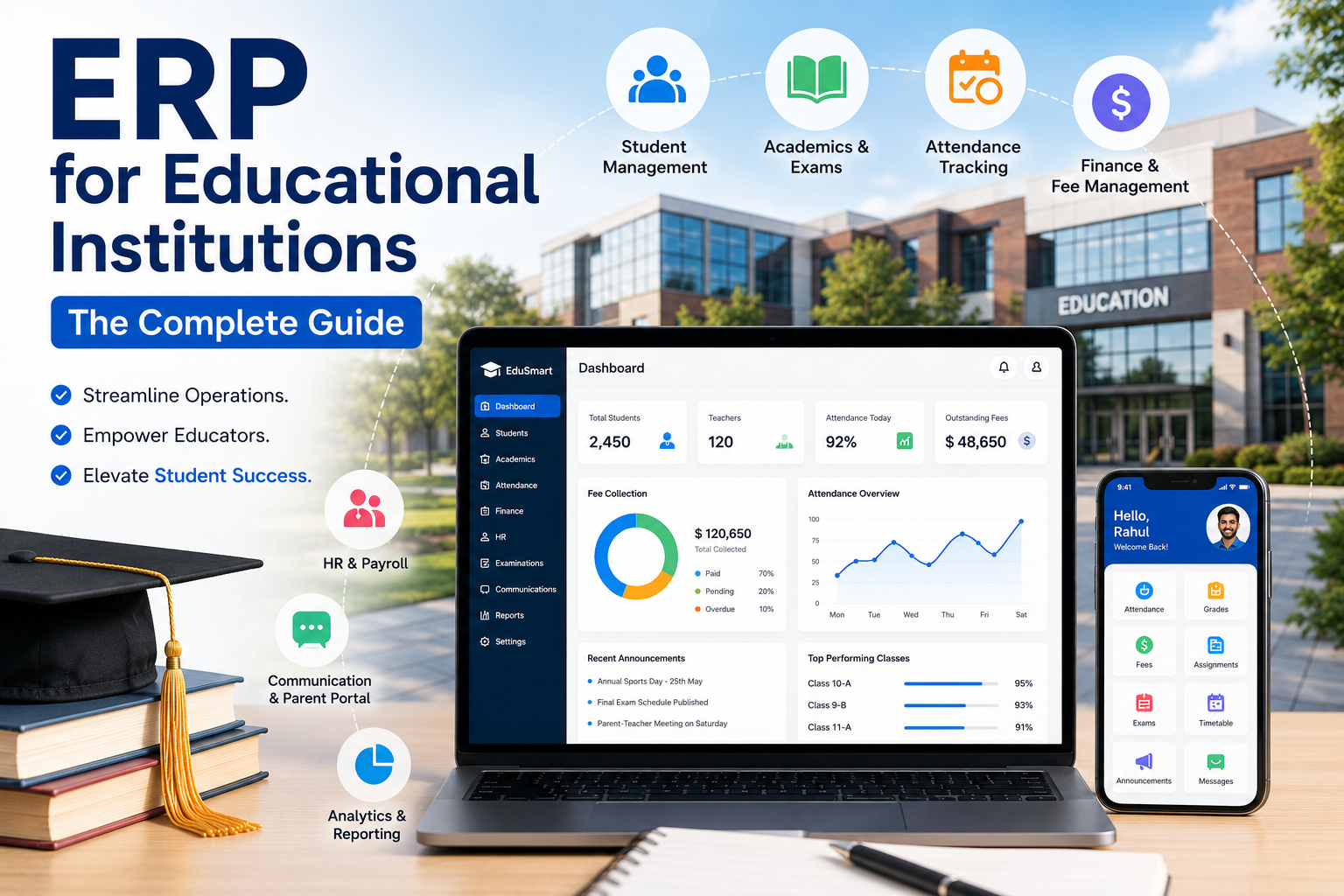
ERP for Educational Institutions: The Complete Guide
Whether you run a primary school, a private academy, or a multi-campus university, ERP for educational institutions is now the operational backbone of modern academic management. This guide covers everything what education ERP is, why it matters, how to evaluate platforms, and which features actually move the needle for schools and colleges.
What Is ERP for Educational Institutions?
An ERP for educational institutions (Enterprise Resource Planning system) is a unified software platform that integrates all of a school's or university's core operations student admissions, academics, HR, finance, attendance, communication, and reporting into a single, connected system.
Unlike general-purpose business ERP (originally built for manufacturing and retail), an education ERP is designed around the unique workflows of academic environments: semester-based scheduling, student lifecycle management, grade tracking, curriculum planning, and compliance with education regulations.
Simple definition
Instead of using ten separate tools for attendance, fee collection, timetables, HR, and reporting, an education ERP brings all of these into one dashboard reducing errors, saving time, and giving leadership real-time visibility into institutional performance.
The concept evolved from traditional enterprise software but has been substantially redesigned for education. To understand how far these systems have come, see our deep comparison: Traditional ERP vs Modern Education Management Systems
Why Educational Institutions Need ERP in 2026
The administrative complexity of running an educational institution has grown dramatically. A mid-sized school today manages thousands of student records, coordinates dozens of staff, tracks real-time attendance, processes fee payments, schedules hundreds of classes, and must report on all of it often simultaneously.
68% of school administrators report spending more than 3 hours/day on manual admin tasks
40% reduction in administrative overhead reported by institutions after ERP implementation
3× faster reporting and compliance documentation with integrated ERP vs. siloed systems
Manual processes and disconnected tools create a compounding problem: data lives in spreadsheets, attendance is tracked on paper, finance is handled separately, and no one has a complete picture of what's happening across the institution. For a thorough look at these friction points, read our full breakdown: How Educational Operations Software Is Revolutionizing Schools in 2026
Core Modules of an Education ERP System
A well-built ERP for educational institutions is modular — meaning you can activate the components your institution needs today and expand as you grow. Here are the foundational modules every serious platform should include:
1. Student Information System (SIS)
The backbone of any education ERP. A student information system centralizes every record: enrollment data, academic history, attendance logs, behavior notes, health records, and parent contact details. Staff no longer need to dig through separate folders or databases — everything is in one profile.
2. Academic Management & Scheduling
Curriculum design, timetable generation, classroom assignment, exam scheduling, and grade management all live here. A strong academic management platform automates timetable conflicts, tracks syllabus progress, and gives teachers instant access to class rosters and performance data.
3. HR & Payroll Management
Managing faculty contracts, leave tracking, payroll processing, performance reviews, and professional development is a significant operational challenge for schools and universities. An integrated HR module eliminates the need for a separate HRMS and keeps staff data connected to teaching schedules.
4. Finance & Fee Management
From fee collection and invoicing to budget planning and financial reporting, the finance module gives finance officers real-time visibility into cash flow, outstanding payments, and departmental spend. Automated reminders and online payment integrations reduce fee collection delays significantly.
5. Attendance Tracking
Whether it's RFID-based, biometric, or manual entry, attendance tracking should feed directly into the student record and trigger automatic alerts to parents when a student is absent. Real-time attendance data also supports compliance reporting for government-funded institutions.
6. Communication & Parent Portal
Keeping parents, students, faculty, and administrators connected reduces friction at every level. Built-in messaging, announcement broadcasts, event calendars, and a parent portal that shows grades, attendance, and fee status improve community trust and engagement.
7. Analytics & Reporting
Leadership needs real-time data, not end-of-term surprises. An analytics dashboard that surfaces enrollment trends, academic performance, attendance patterns, and financial health allows principals, deans, and board members to make proactive decisions rather than reactive ones.
ERP for Different Types of Educational Institutions
Not every institution has the same needs. Here's how ERP requirements typically vary across different educational contexts:
| Institution Type | Key ERP Priorities | Typical Scale |
|---|---|---|
| Primary & Secondary Schools | Student records, attendance, parent communication, fee management | 100–3,000 students |
| Private Academies & Language Institutes | Course scheduling, enrollment flows, multi-language support, billing | 50–500 students |
| Colleges | Department management, exam boards, faculty workload tracking, grants | 500–10,000 students |
| Universities | Multi-campus support, research management, alumni tracking, complex HR | 5,000–100,000+ students |
| Vocational & Training Centers | Industry certifications, practical assessment tracking, employer portals | 100–2,000 students |
For institutions at the college and university level, the complexity of ERP requirements increases substantially. Our dedicated guide covers exactly what's needed: ERP for Colleges and Universities: A Complete Institutional Guide
What Makes a System an Academic ERP?
The term academic ERP system is sometimes used interchangeably with "education ERP," but it typically refers more specifically to the academic core: curriculum management, learning outcome tracking, grade books, faculty assignment, and academic planning tools.
A true academic ERP system goes beyond administrative functions — it connects institutional strategy (what outcomes you're targeting) to classroom execution (how each course and teacher contributes to those outcomes) and back to leadership reporting. This closed loop is what separates an academic ERP from a simple student information system.
Key distinction
A student information system (SIS) stores data. An academic ERP system acts on that data automating workflows, triggering alerts, generating reports, and connecting departments that previously operated in isolation.
For a complete breakdown of what an academic ERP system includes and how to evaluate one for your institution: Academic ERP System: The Complete Institutional Guide
Cloud-Based vs On-Premise ERP for Schools
One of the most consequential decisions in any ERP evaluation is the deployment model. Should your institution run an on-premise system it controls entirely, or move to a cloud-based platform?
| Factor | Cloud-Based ERP | On-Premise ERP |
|---|---|---|
| Upfront cost | Low (subscription model) | High (licensing + hardware) |
| Implementation time | Weeks to a few months | 6–18 months |
| IT staff required | Minimal | Significant |
| Updates & maintenance | ✔ Vendor-managed | ✘ Institution's responsibility |
| Data control | Shared (vendor infrastructure) | Full ownership |
| Remote access | ✔ Any device, anywhere | ✘ Typically campus-only |
| Scalability | ✔ Instant | ✘ Requires hardware upgrades |
| Best for | Most schools and growing institutions | Large universities with strict data sovereignty requirements |
For the vast majority of educational institutions particularly schools, academies, and mid-sized colleges cloud-based ERP is the right choice in 2026. The lower cost of entry, faster deployment, and reduced IT burden far outweigh the loss of full infrastructure control for most use cases.
For a complete guide to cloud ERP options, features, and what to look for in a provider: Cloud-Based School ERP: Everything Schools Need to Know
Key Benefits of ERP for Educational Institutions
Implementing an ERP system is a significant investment of time, money, and organizational change. When it's done right, the returns are substantial and measurable across every layer of the institution.
Operational Efficiency
Administrative tasks that once took hours generating reports, processing fee payments, scheduling exams, updating attendance records are automated or completed in minutes. Staff redirect that time toward student-facing work.
Single Source of Truth
When student data, financial records, HR information, and academic performance all live in one system, there's no reconciliation problem. Every stakeholder sees the same, current information.
Improved Parent & Student Communication
Parent portals, automated attendance alerts, real-time grade visibility, and announcement tools keep families engaged without burdening teachers with repetitive communication tasks.
Data-Driven Decision Making
Leadership can see enrollment trends, identify at-risk students before they fall through the cracks, track departmental spend against budget, and benchmark institutional performance over time all from a single dashboard.
Regulatory Compliance
Schools must comply with government reporting requirements, data protection regulations (like GDPR), and institutional accreditation standards. A well-configured ERP automates much of this compliance documentation.
Scalability
Whether your institution grows from 200 to 2,000 students, adds new campuses, or expands into new programs, an ERP scales with you without requiring a complete system overhaul.
For a comprehensive breakdown of every benefit category with real institutional examples: ERP Software for Schools: Features, Benefits & How to Choose
How to Choose the Right ERP for Your Educational Institution
Choosing an ERP is not just a technology decision it's an institutional strategy decision. The right system depends on your institution's size, growth trajectory, budget, technical capacity, and the specific pain points you're trying to solve.
Step-by-Step Evaluation Framework
Audit your current processes
Before evaluating any platform, map your current administrative workflows. Identify where data gets lost, where staff spend the most time, and where errors occur most frequently. This becomes your requirements list.
Define your non-negotiable features
Every institution has different priorities. A language academy needs flexible course scheduling. A university needs multi-department HR. A K-12 school prioritizes parent communication and attendance. Know your top 5 requirements before you start demos.
Evaluate deployment models
Decide between cloud-based, on-premise, or hybrid. For most schools in 2026, cloud is the practical choice but validate that any vendor meets your data residency and security requirements.
Assess total cost of ownership
License or subscription cost is only part of the picture. Factor in implementation, data migration, training, ongoing support, and the cost of any required integrations with existing tools.
Run a structured pilot
Before committing, run a limited pilot with 1–2 departments. Evaluate ease of use for non-technical staff, data import quality, reporting flexibility, and vendor responsiveness to issues.
Plan the implementation carefully
The most common reason ERP projects fail is poor change management not the software itself. Assign an internal project lead, set a realistic rollout timeline, plan parallel operation during transition, and invest in staff training.
Pro tip
Ask every vendor candidate for three references from institutions of a similar size and type to yours. Speak to the admin staff who use the system daily, not just the IT director who managed the implementation.
Top ERP Systems for Educational Institutions in 2026
The education ERP market has matured significantly. There are now purpose-built solutions for every institution type and budget from lightweight school management tools to enterprise-grade university platforms.
When evaluating options, the key differentiators to assess are: depth of academic management features, quality of parent/student-facing portals, reporting flexibility, implementation support, and total cost of ownership over a 3-year horizon.
Clast is one of the leading platforms built specifically for educational institutions covering the full spectrum from language academies and schools to colleges and universities. It combines student management, academic delivery, HR, finance, communication, and analytics in a single cloud-based platform with no per-module add-on fees.
For a side-by-side evaluation of the top 7 ERP systems for schools and institutions including features, pricing, and honest pros/cons see our full comparison: Best ERP Software for Schools in 2026: Top 7 Systems Compared
Implementing ERP in Your Institution: What to Expect
A typical ERP implementation for a mid-sized school runs 6–16 weeks for a cloud-based system, and 6–18 months for on-premise. The phases generally look like this:
| Phase | Timeline | Key Activities |
|---|---|---|
| Discovery & Planning | Weeks 1–2 | Requirements gathering, stakeholder mapping, data audit |
| Configuration | Weeks 3–6 | System setup, module configuration, user role definition |
| Data Migration | Weeks 5–8 | Historical data import, data validation, deduplication |
| Training | Weeks 7–10 | Admin training, teacher onboarding, parent portal walkthrough |
| Parallel Operation | Weeks 9–12 | Running old & new systems simultaneously to validate accuracy |
| Go Live | Week 12–16 | Full cutover, hypercare support, issue resolution |
The biggest risk at every phase is insufficient staff training and communication. Institutions that invest in structured change management including clear rationale communication to all staff, hands-on training sessions, and designated "ERP champions" in each department report significantly smoother transitions and faster time-to-value.
Conclusion
In 2026, ERP systems have become essential for educational institutions looking to streamline operations, improve communication, and make data-driven decisions. By bringing academics, administration, finance, HR, and student management into one connected platform, education ERP software helps institutions operate more efficiently and scale with confidence. The key is choosing a system that fits your institution’s unique needs today while supporting future growth.