
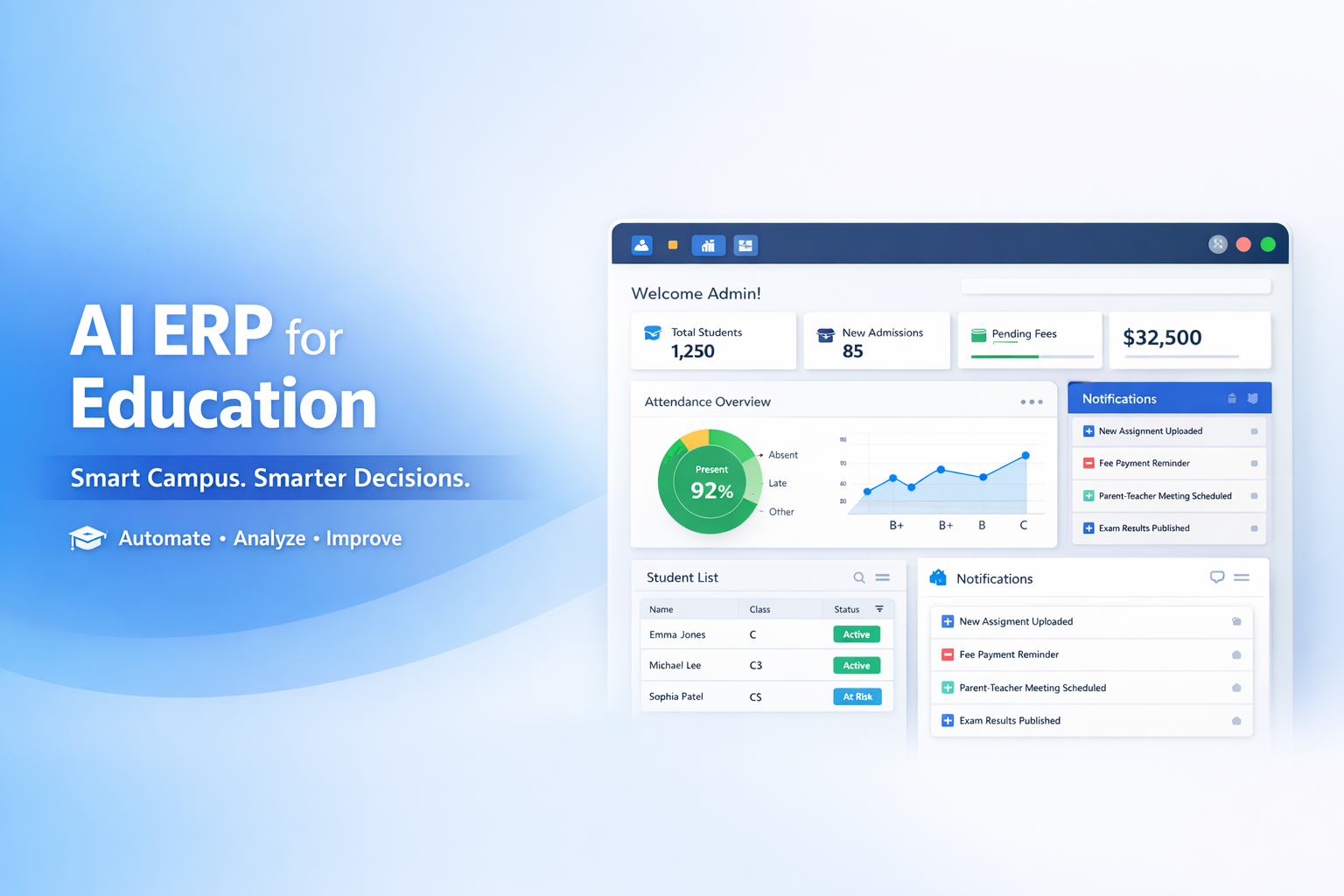
Managing a modern educational institution has never been more complex. Schools, colleges, and universities must simultaneously handle admissions, attendance, fee collection, academic performance tracking, communication, and compliance often across hundreds or thousands of students.
Yet most institutions still run on disconnected tools: a spreadsheet here, a standalone fee system there, a WhatsApp group for parent communication. The result is wasted hours, data errors, frustrated staff, and students who fall through the cracks.
AI ERP for education changes this entirely. This guide explains what it is, what problems it solves, what features matter, and how to choose the right system whether you run a small school or a large university.
What Is AI ERP for Education?
AI ERP for education is a centralized, AI-powered software platform that manages all institutional operations from admissions and attendance to finance and academic performance in a single unified system.
Traditional ERP systems already help store data in one place. But they still require constant manual input, generate static reports, and offer no predictive capability.
AI ERP goes further. It doesn't just store information it analyzes it, detects patterns, and acts on them.
How It Differs from Traditional ERP Systems
A conventional school ERP might show you that a student missed 10 classes last month. An AI ERP will detect the attendance decline early, cross-reference it with assignment submission rates and grade trends, and automatically alert the student's advisor before the situation escalates.
That shift from reactive data storage to proactive intelligence is the defining difference.
Key AI Capabilities That Set It Apart
- Predictive analytics : forecast enrollment trends, dropout risks, and resource needs
- Automated workflows : remove manual steps from admissions, attendance, and reporting
- Natural language processing : enable staff and students to query data conversationally
- Smart alerts : surface problems before they become crises
- Personalization engines : tailor communication and support to individual students
Think of AI ERP as the operating system for your institution the central intelligence layer that connects every department and makes the data actually useful.
Key Challenges in Education And How AI ERP Solves Them
1. Heavy Administrative Workload
Administrative staff at most schools spend 30–50% of their time on tasks that could be automated: data entry, generating attendance reports, creating timetables, processing fee reminders.
How AI ERP helps:
- Automates attendance tracking (including biometric or QR-based options)
- Generates real-time dashboards replacing manual monthly reports
- Schedules automated fee reminders and follow-ups
- Reduces administrative workload by 40–60% (based on industry benchmarks)
2. Scattered and Inconsistent Data
Most institutions use one system for academics, another for finance, and yet another for admissions with no integration between them. This creates duplicate records, delays, and decisions based on incomplete information.
AI ERP solution: All institutional data lives in one place. Every department sees the same real-time information, eliminating the "which spreadsheet is current?" problem.
3. Poor Communication Between Stakeholders
When teachers, students, parents, and administrators communicate across WhatsApp groups, email chains, and notice boards, important messages get missed and accountability disappears.
AI ERP fixes this with:
- Built-in messaging and announcement systems
- Automated notifications for fees, results, and events
- AI chatbots that answer routine queries instantly (what's the fee due date? when are exams?)
- Parent portals with real-time visibility into attendance and grades
4. Lack of Data-Driven Decision Making
Without integrated data, principals and academic directors make decisions based on gut instinct or outdated reports. Which courses are underperforming? Which teachers have the highest student engagement? Which cohort is at highest dropout risk?
With AI ERP: These answers are available in seconds not after a week of data gathering.
5. Inefficient Admission Processes
Manual admission cycles involve paper forms, physical document verification, and weeks of back-and-forth. Applicants drop off. Staff get overwhelmed. Errors creep in.
AI ERP improves this by:
- Digitizing the entire application journey
- Automating document verification and eligibility scoring
- Sending real-time status updates to applicants
- Reducing admission cycle time by 50–70%
How AI ERP Improves Student Experience
Personalized Learning Support
Every student has a different learning pace, attendance pattern, and academic strength. Yet traditional systems treat all students identically.
AI ERP tracks individual performance patterns, identifies at-risk students early, and suggests targeted interventions. If a student's math scores decline over three assessments, the system can automatically notify their teacher and recommend supplemental resources before the student fails an exam.
Instant Access to Information
Students no longer need to visit the admin office to check their attendance percentage, exam timetable, or fee balance. AI ERP provides mobile-accessible student portals where everything is available 24/7.
This reduces footfall at admin counters, frees up staff time, and significantly improves student satisfaction.
Better Communication and Engagement
With automated reminders, real-time notifications, and direct messaging built into the platform, students and parents stay informed without requiring constant manual effort from staff. Engagement rises. Missed deadlines drop.
Core Features of an AI-Powered ERP System for Education
Not every system sold as "AI ERP" actually delivers meaningful AI capability Here's what to look for
1. Student Information Management
A complete, single-record system for every student: personal details, academic history, attendance, disciplinary records, and performance data. Critically, it should be searchable, filterable, and accessible to the right people in real time.
2. Attendance and Timetable Automation
Automated attendance capture (via QR codes, biometric integration, or teacher apps) combined with conflict-free timetable generation. The AI should flag attendance anomalies automatically, not just log them.
3. Financial Management and Fee Tracking
End-to-end fee management: collection, invoicing, overdue tracking, partial payment handling, and financial reporting. Automated reminders reduce late payments without requiring staff involvement.
4. AI-Based Analytics and Predictive Insights
This is where real differentiation happens. Look for:
- Student performance trend analysis
- Dropout and at-risk student prediction
- Enrollment forecasting
- Department-level performance dashboards
- Customizable reports for leadership
5. Communication and Collaboration Tools
Built-in messaging between teachers, students, parents, and staff. Announcement broadcast tools. AI chatbots for routine queries. Integration with email and SMS for those outside the platform.
6. Mobile Accessibility
In 2026, a system without a well-designed mobile app is incomplete. Students, parents, and teachers need access from any device. Look for Android and iOS apps with offline capability for connectivity-limited environments.
AI ERP for Universities vs Schools vs Colleges
Higher Education Use Cases
Universities and colleges face unique complexity: multiple campuses, department autonomy, research administration, alumni management, and regulatory compliance. AI ERP for higher education needs:
- Multi-campus architecture
- Faculty workload and research management
- Integration with learning management systems (LMS)
- Alumni and placement tracking
- Compliance reporting for accreditation bodies
Keyword context: Systems marketed as "intelligent ERP for universities" or "AI operating system for educational institutions" typically target this segment.
K-12 and School-Specific Needs
Schools prioritize different features: parent communication, homework tracking, behavior management, and simplified fee collection. Smaller institutions benefit from systems that are easy to deploy without large IT teams.
AI school ERP platforms designed for K-12 often include parent-teacher meeting schedulers, report card generation, and transport management features less relevant to universities.
Automation in Educational ERP: What Gets Automated?
Automation is the most immediate ROI driver in educational ERP. Here's a practical breakdown:
| Process | Without Automation | With AI ERP |
|---|---|---|
| Daily attendance | Manual register or Excel | Auto-captured, synced in real time |
| Fee reminders | Staff calls/WhatsApp | Automated SMS/email on schedule |
| Timetable creation | Days of manual planning | AI-generated, conflict-free |
| Admission processing | Paper forms + manual review | Digital, scored, and tracked |
| Performance reports | Monthly manual compilation | Real-time dashboard |
| Parent communication | Individual messages | Broadcast + auto-notifications |
The institutions that see the fastest ROI from AI ERP are those that map their highest-volume manual processes first and automate them immediately.
How to Choose the Right AI ERP System for Your Institution
Before signing a contract, run every vendor through this checklist:
Functional fit:
- Does it cover academics, finance, admissions, and communication in one platform?
- Does it offer genuine AI capabilities (prediction, automation, anomaly detection) or just basic reporting?
- Does it support your institution type (school, college, university)?
Technical requirements:
- Is it cloud-based with regular updates, or on-premise requiring IT maintenance?
- Does it integrate with your existing LMS, accounting software, or HR system?
- What are the data security and GDPR/local compliance standards?
Usability:
- Can non-technical staff use it without training weeks?
- Is there a mobile app for students and parents?
- What does the onboarding and support process look like?
Scalability:
- Will it scale as enrollment grows?
- Are pricing tiers based on students, features, or usage?
Pro tip: Always request a live demo using your own institutional data scenarios not a pre-scripted walkthrough. Ask what happens when attendance data is missing, or when a fee payment fails to process.
Conclusion
AI ERP for education is no longer a future investment it's the operational backbone that high-performing institutions are building on today.
The difference between institutions that thrive and those that struggle increasingly comes down to how well they use data. Manual processes and disconnected systems don't just waste time they hide the insights that could prevent student dropout, accelerate admissions, and free teachers to focus on teaching.
Choosing the right AI ERP system means choosing a platform that doesn't just manage your data, but makes it work for you automatically, intelligently, and in real time.
Ready to see what AI ERP can do for your institution? Explore Clast's platform and request a live demo.