
A school secretary spends twenty minutes hunting for a transfer certificate that should have taken thirty seconds to find. A vice principal builds next term's timetable by hand for the fourth year running, because the last "digital solution" the school bought turned out to be a glorified spreadsheet. A finance officer chases the same fifteen families every single month for overdue fees, one phone call at a time.
None of this is a staffing problem. It's a systems problem and it's the exact kind of problem artificial intelligence is good at solving. Not by replacing the secretary, the vice principal, or the finance officer, but by doing the parts of their jobs that are really just pattern-matching in disguise: predicting who's about to fall behind, building a timetable from constraints in seconds instead of days, or spotting which families are likely to miss a payment before the due date arrives.
That's what this guide covers what AI in school administration actually does today, where vendors oversell it, what it realistically costs, how to tell a genuine AI feature from a marketing label, and how to roll one out without blowing up your school year in the process.
What "AI in School Administration" Actually Means
The phrase gets thrown around loosely enough that it's worth defining before going further. A dropdown menu that auto-fills a form isn't AI. A system that reads five years of attendance data and correctly predicts, in week four, which students are on track to become chronically absent by week twelve before any teacher has consciously noticed the pattern is.
In practice, AI in this context means software that can do a few specific things:
- Learn from historical data (attendance, grades, payments, inquiries) to make predictions about what's likely to happen next
- Handle multi-step decisions on its own, like routing a leave request through approval or generating a full timetable, rather than just storing information for a human to act on
- Understand plain-language requests, so a staff member can type "show me Year 8 attendance for this term" instead of navigating five menus
- Flag anomalies that would take a person hours of manual review to spot
Why the distinction matters: plenty of what gets marketed as "AI-powered" in this space is really automated reminders and pre-built reports wearing a new label. Vendors in this industry have started admitting as much themselves. Knowing the difference before you sign a contract will save you both money and disappointment.
Why This Is Becoming Urgent Now
Administrative overhead isn't a minor inconvenience it's a documented drain on capacity. Staff routinely report losing large chunks of their week to tasks like file retrieval, manual attendance reconciliation, and repetitive parent communication, and none of that scales down as a school grows. It scales up.
Meanwhile, schools are sitting on more data than they've ever had: learning management system logs, biometric attendance records, payment histories, admissions funnels, behavior reports. Almost all of it just sits there, collected but unused. AI's real value proposition isn't novelty it's turning that dormant data into something administrators can act on before a small problem becomes an expensive one.
Where AI Is Actually Delivering Value
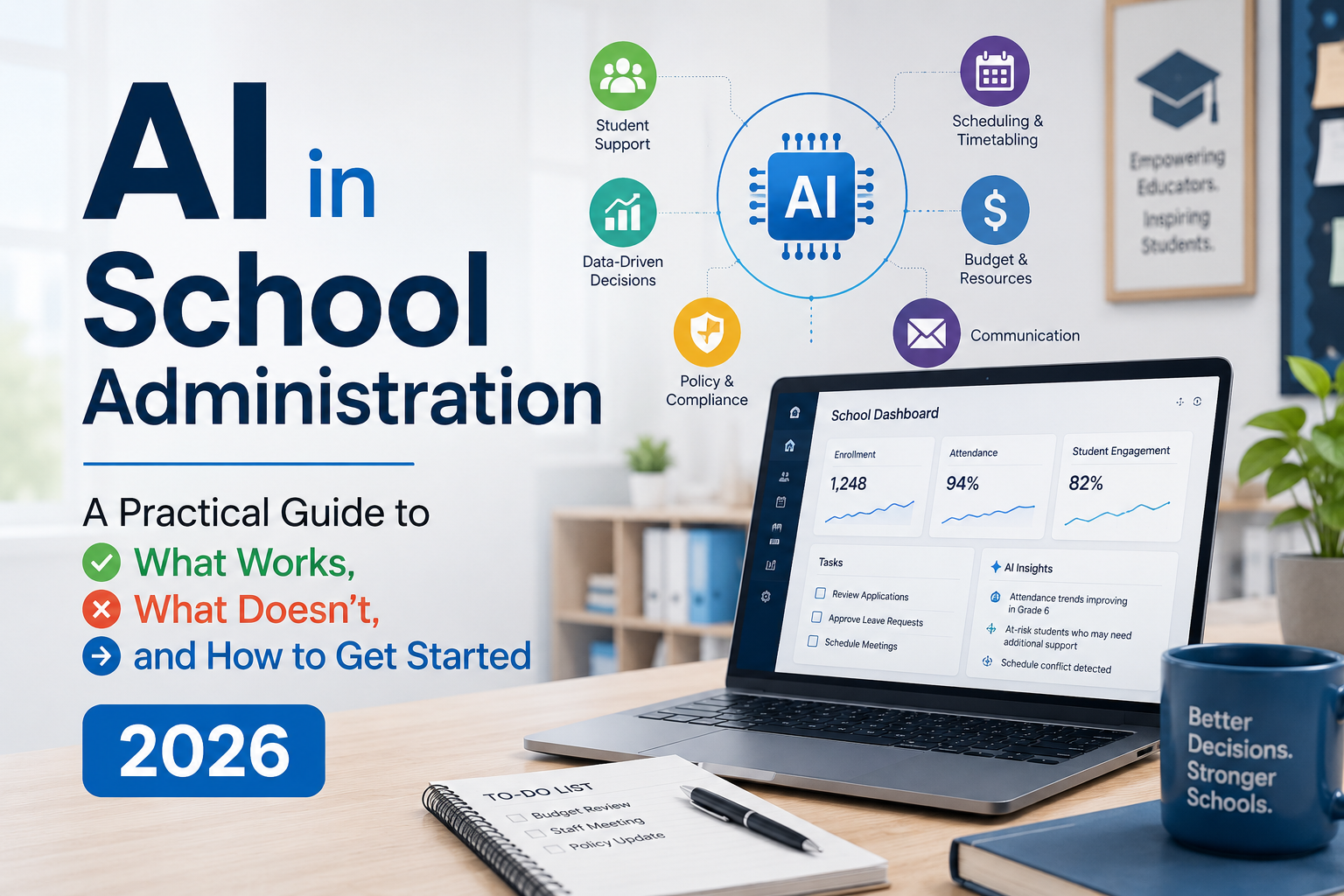
Strip away the marketing language, and AI in school administration clusters into a handful of functional areas where it's genuinely earning its keep.
| Function | What AI Does | Administrative Payoff |
|---|---|---|
| Attendance | Detects absence patterns, predicts chronic absenteeism risk | Earlier intervention, fewer surprises at term-end |
| Enrollment & admissions | Scores inquiry quality, forecasts intake numbers | Better staffing decisions, less last-minute scrambling |
| Scheduling & timetabling | Builds conflict-free timetables from constraints | Days of manual work compressed into minutes |
| Communication | Drafts, segments, and personalizes outreach | Fewer generic blasts, higher parent engagement |
| Finance & billing | Predicts late payments, automates reminders | Improved cash flow, less manual follow-up |
| HR & staffing | Screens applications, flags payroll anomalies, forecasts staffing needs | Faster hiring cycles, fewer payroll errors |
| Compliance & reporting | Auto-generates audit-ready reports, flags missing records | Hours saved per reporting cycle |
| Document management | Auto-names, tags, and files records; flags retention deadlines | Faster retrieval, fewer compliance gaps |
| Safeguarding & security | Monitors access logs, flags unusual visitor or entry patterns | Faster response to safety concerns |
A closer look at where each of these actually earns its place:
Attendance and early warning. This is arguably the clearest win in the whole category. Instead of a teacher noticing in week eight that a student has been quietly checked out since week three, a system trained on attendance, submission rates, and engagement data can catch the pattern in week four, while there's still time to do something about it. Some schools have already paired this with facial-recognition attendance capture, which removes the manual roll-call entirely and triggers a parent notification automatically.
Enrollment forecasting. Admissions has traditionally run on gut feel and last year's numbers taped to a whiteboard. AI-assisted forecasting replaces that with historical inquiry-to-enrollment conversion data, marketing channel performance, and seasonal patterns, so admissions teams can prioritize follow-up during peak periods and plan classroom capacity in the spring instead of scrambling in August.
Timetabling. Building a timetable means satisfying teacher availability, room capacity, subject requirements, and student groupings all at once which is exactly the kind of constraint-satisfaction problem software is built for. What used to take a vice principal several days by hand now takes minutes, and when a teacher calls in sick or a room floods, the system can regenerate around the disruption instead of starting from scratch.
Communication. The real shift here isn't automation it's segmentation. A family that's toured the campus twice and downloaded the prospectus shouldn't get the same follow-up email as one that submitted a single online form and went quiet. AI-driven segmentation makes that kind of personalization possible at scale, and natural-language tools increasingly let a staff member type "draft a letter to parents with outstanding fees" and get something usable back immediately.
Finance and resource planning. AI can look at historical payment behavior and flag which families are statistically likely to miss a due date, so the outreach happens before the payment is late rather than after it. The same approach extends to budgeting: flagging staffing cost trends, energy consumption spikes, or procurement anomalies before they turn into a shortfall.
HR and staff administration. This gets far less attention than the student-facing side of things, but it's just as real. AI is being used to screen applications against role requirements, catch payroll anomalies like duplicate payments or miscalculated overtime, and forecast staffing needs against enrollment trends cutting both hiring time and the kind of payroll errors that are expensive to unwind.
Compliance and document management. Nobody wants to spend the week before an audit assembling evidence from four different filing cabinets and a shared drive nobody's cleaned since 2021. AI tools can auto-tag documents on upload, flag records that are missing or approaching their retention deadline, and generate a compliance-ready report on request turning a multi-day scramble into an afternoon.
Safeguarding. A quieter but growing use case: AI-assisted visitor management and access monitoring can flag unusual entry patterns in real time, giving safeguarding leads a head start that scrolling through camera logs never gave them.
The Hype vs the Reality
Before you evaluate a single AI feature, it's worth being honest about where the line actually sits.
AI is reliably good at finding patterns in large, structured datasets attendance, payments, engagement logs and at repetitive drafting work like letters, reports, and timetables. It's reliably bad at replacing professional judgment on anything involving a student's wellbeing or a staff disciplinary matter, and it performs poorly on messy, incomplete, or siloed data, because it's only ever as good as the foundation underneath it. It also doesn't work well unattended: every AI system produces errors, and the real question isn't whether they happen but whether the platform surfaces them for a human to catch, or buries them in an output nobody double-checks.
The most useful version of this technology, in practice, isn't a separate AI tool bolted onto systems your school already runs. It's AI quietly embedded inside the platforms you already use, drawing on data you're already collecting, surfacing insights in the workflows your staff are already sitting in every day.
The Real Benefits
- Time back. Automating attendance tracking, filing, and report generation frees staff for work that actually needs a human.
- Fewer mistakes. Automated data entry and validation catch the kind of small manual errors that compound over a school year.
- Sharper decisions. Real-time dashboards replace "I think enrollment is down" with an actual number.
- Healthier cash flow. Predictive billing shrinks the pile of overdue accounts before it grows.
- Earlier intervention. Attendance and performance flags surface at-risk students weeks before a report card would.
- Less burnout. Removing repetitive administrative friction is directly linked to lower turnover in school business teams this isn't a minor perk, it's often the difference between keeping good staff and losing them.
Challenges and Risks Worth Taking Seriously
Every credible source on this topic, academic and vendor alike, converges on the same short list of risks. Treat them as planning items, not fine print.
Data privacy and security. Student and staff data is about as sensitive as institutional data gets. Before adopting anything, get straight answers on where it's hosted and under which jurisdiction, whether your data trains the vendor's shared models or stays walled off in your own environment, what access controls exist around AI-generated insights, and whether the platform actually complies with the regulations that apply to you FERPA and COPPA in the U.S., UK GDPR and Department for Education guidance in the UK, the EU AI Act and GDPR across Europe, or India's Digital Personal Data Protection Act. These frameworks differ meaningfully by region, so a vendor's blanket "we're compliant" claim is only as good as which law they actually mean.
Algorithmic bias. Models trained on historical data can just as easily encode historical inequities as they can catch genuine risk flagging certain groups as "higher risk" based on patterns that reflect past discrimination rather than anything predictive. This calls for ongoing auditing, not a one-time check during procurement.
Cost. Initial investment in tools, integration, and training can be substantial, especially for schools working with tight budgets. Budget honestly for licensing, the work of connecting a new system to what you already run, and a training period where things may get slightly harder before they get easier.
Job security concerns. It's a reasonable worry, and dismissing it outright doesn't help anyone. What the evidence consistently shows is that AI redistributes administrative time toward higher-value work rather than eliminating roles but that reassurance only holds up if leadership is transparent about it from the very start of the rollout, not after staff have already started asking questions.
Over-reliance. An AI flag on a student's academic trajectory is a judgment that will shape how staff respond to that student. That judgment needs a human checking it. AI should inform a decision. It shouldn't be allowed to quietly make one.
How to Evaluate a Vendor Without Getting Sold a Buzzword
Run any tool you're considering through this list before you sign anything:
- Is the AI embedded or bolted on? Embedded AI that draws on data your school already generates delivers value faster than a standalone add-on that needs its own separate data feed.
- Can they show you a live demo on data like yours not a slide deck of hypothetical screenshots?
- Can it explain its own recommendations? If staff can't see why something was flagged, they won't trust it, and if they don't trust it, they won't use it.
- What happens when it's wrong? Every system errs eventually. Ask specifically how corrections get surfaced and applied.
- Does it get better with your data over time, or is what you see in the demo all you'll ever get?
- What's the actual total cost licensing, integration, training, ongoing support not just the number on the pricing page?
- What's their policy on training their models with your student data? Get this in writing, not in a sales call.
A Rollout Plan That Won't Blow Up Your Term
Most AI rollouts fail one of two ways: nothing happens because the whole project feels too big to start, or everything happens at once and staff revolt by October. A phased approach avoids both.
Weeks 1–2 — Audit and prioritize. Identify your three most time-consuming administrative bottlenecks. Start with whichever one will show results fastest, not the hardest one attendance tracking and document filing are common first wins for a reason.
Weeks 3–4 — Select and pilot. Pick a tool that addresses your top bottleneck and actually integrates with what you already run. Test it with one grade level or one department before rolling it out school-wide.
Weeks 5–8 — Train in stages. Give the pilot group hands-on training, collect feedback, and adjust configuration before you expand further.
Months 3–4 — Scale gradually. Extend to more departments based on what the pilot actually revealed, not what the vendor promised. Resist the urge to switch everything on at once.
Ongoing — Measure and audit. Track time saved, errors avoided, and staff satisfaction. Revisit the privacy and bias questions on a recurring schedule this isn't a box you check once at purchase and forget.
An Illustrative Example
Picture a mid-sized school that automates attendance filing and leave approvals through an AI-enabled workflow: intake gets digitized, records are auto-tagged by student and date, and approvals route automatically instead of moving through a paper sign-off chain. Schools implementing this kind of workflow commonly report cutting administrative time on these tasks by roughly a third to a half within the first couple of months, along with noticeably faster audit preparation. Results will vary by school size and by how clean the underlying data was to begin with this is meant to illustrate the pattern, not promise a guaranteed outcome for every school.
Where This Is Headed
Three things are likely to accelerate over the next few years. Natural-language interfaces will let any staff member query school data in plain English instead of needing specialist training to pull a report. AI insight will keep getting folded directly into the platforms schools already run, rather than living in a separate "AI dashboard" nobody opens. And regulatory scrutiny will keep tightening, which means vendor transparency about how they handle your data will become a genuine competitive differentiator rather than a line in the terms of service nobody reads.
The schools that get the most out of this won't be the ones chasing every new AI feature that hits the market. They'll be the ones that adopt deliberately starting from a real problem, a clean data foundation, and a plan for human oversight built in from day one, not bolted on after something goes wrong.
Conclusion
AI in school administration isn't a single product you buy off a shelf it's a set of capabilities you adopt one well-chosen problem at a time. The schools seeing real returns aren't the ones with the longest feature list. They're the ones that picked their worst bottleneck, asked vendors the uncomfortable questions about data and oversight before signing anything, piloted before scaling, and kept a human firmly in the loop the whole way through.
If you're weighing where to start, begin with whichever administrative task currently eats the most staff time for the least strategic value for most schools, that's attendance, filing, or fee collection. Run a small pilot, measure it honestly, and let the results decide whether it's worth scaling.
Ready to move from research to action? Start by mapping your own administrative bottlenecks against the checklist above, then request live demos not slide decks from two or three vendors whose AI is embedded in tools you already use. That single step will tell you more about what's genuinely possible for your school than any amount of further reading.