
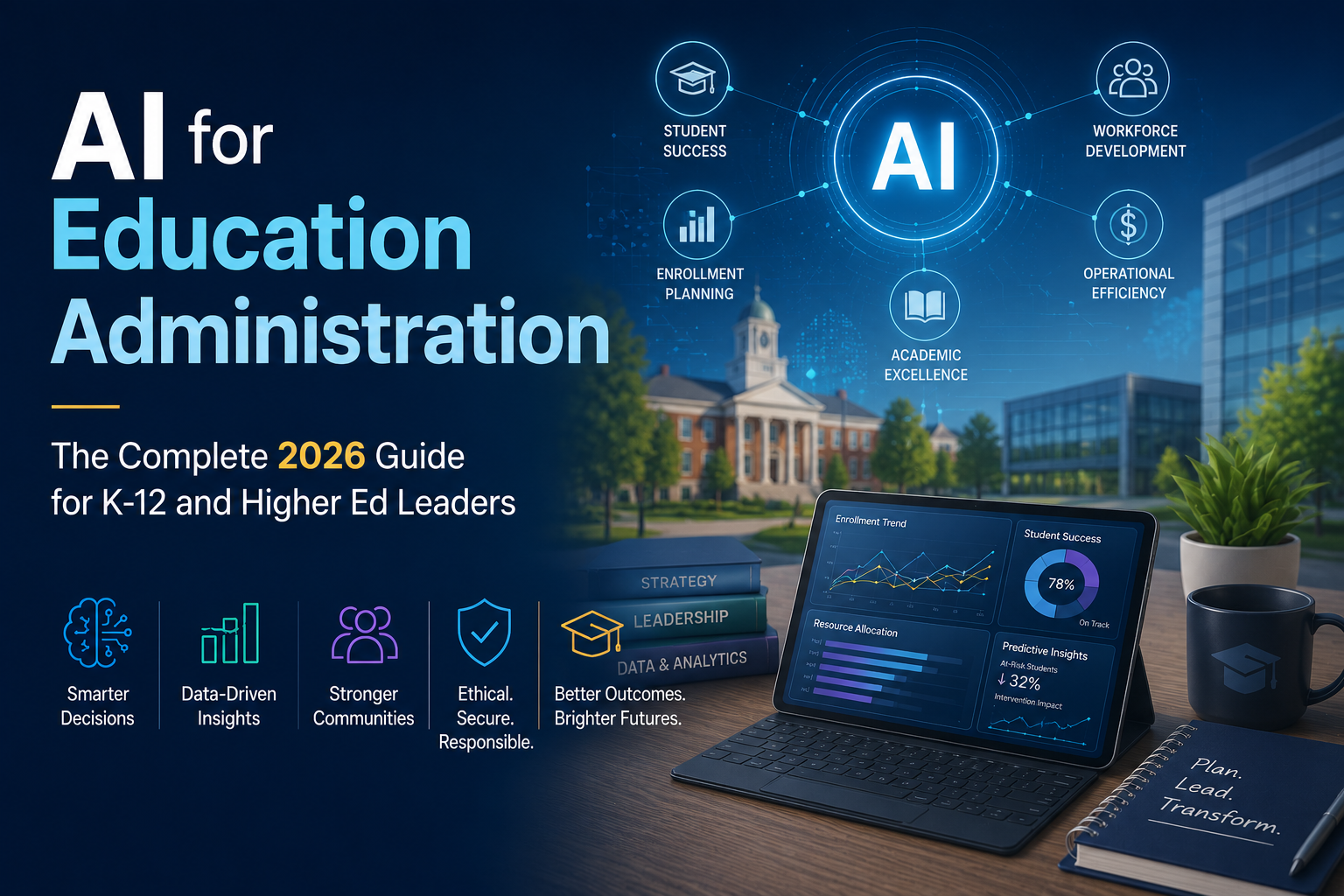
Education administrators are under more pressure than ever: shrinking budgets, staff shortages, mounting compliance requirements, and a demographic shift that's about to shrink the pool of incoming college students. At the same time, a new class of tools promises to take routine work off administrators' plates and hand back hours for the strategic work that actually moves the needle.
This guide covers everything a K-12 or higher education leader needs to know about AI for education administration what it is, where it delivers real value, what it costs, how to roll it out responsibly, and how to avoid the most common implementation mistakes.
What Is AI for Education Administration?
AI for education administration is the use of machine learning, natural language processing, and automation technologies to manage the operational and business side of running a school, district, college, or university as distinct from AI used directly in classroom teaching or tutoring.
In practice, that includes systems that:
- Automate repetitive paperwork (enrollment processing, records management, compliance reporting)
- Analyze institutional data to support decisions (enrollment forecasting, budget planning, staffing)
- Handle routine communication (chatbots for admissions and student services questions)
- Flag risk early (students likely to disengage or drop out, fraudulent applications, scheduling conflicts)
- Optimize resources (classroom assignments, staff schedules, transportation routes)
The distinction matters because "AI in education" is a much broader category that includes instructional tools like adaptive learning platforms and AI tutors. Administration-focused AI is narrower: it's built for registrars, admissions offices, business officers, principals, superintendents, and IT leaders rather than for the classroom.
Why Education Administrators Are Turning to AI Now
Three forces are converging to push AI up the priority list for institutional leaders in 2026.
Enrollment pressure is real, though how severe it will be is genuinely disputed. The "demographic cliff" a projected decline in the pool of college-age students starting around 2026 as birth rates dropped after the 2008–2009 recession is well documented by researchers like Nathan Grawe. But the outlook isn't uniformly bleak: Tyton Partners' own research, titled "From Cliff to Escalator," argues the five-year enrollment picture is less dire than the "cliff" framing suggests, with the impact varying enormously by region and institution type. Either way, institutions can no longer count on enrollment growth to paper over budget gaps, which makes operational efficiency a real priority rather than a nice-to-have even if the "cliff" ends up shallower than the most alarming projections.
AI has moved from pilot to infrastructure. Inside Higher Ed's 2026 Survey of College and University Presidents found that 71% of college and university presidents now report an institution-wide AI task force or strategy in place up from 52% the year before and just 18% in 2024. That's a marked shift from just two or three years ago, when AI adoption in administration was still largely experimental.
Staff are already using AI with or without a strategy. Reported faculty use of AI tools has grown sharply year over year in surveys like Cengage Group's GenAI Report, and administrative staff are following the same trajectory. Institutions that don't provide sanctioned tools and clear policy tend to end up with ungoverned "shadow AI" use instead which is a bigger risk than adoption itself.
Key Benefits of AI in Education Administration
| Benefit | What It Looks Like in Practice |
|---|---|
| Time savings | Automating attendance, records processing, and report generation frees staff from repetitive data entry |
| Faster decisions | Real-time dashboards replace static year-end reports for enrollment, budget, and resource planning |
| Earlier risk detection | Predictive models flag at-risk students, expiring compliance documents, or budget overruns before they become crises |
| Lower operational cost | Automating routine workflows reduces the need to add headcount as institutions scale |
| Better communication | Chatbots and messaging tools handle routine inquiries around the clock, cutting response times for students and parents |
| Stronger compliance | Automated tracking of retention schedules and audit trails reduces the risk of missed deadlines or lost documentation |
| More equitable resource use | Data-driven scheduling and allocation reduce the guesswork in staffing, classroom, and budget decisions |
Core AI Applications Across Administrative Functions
Enrollment and Admissions
AI is most mature here. Application-screening systems can sort and rank large applicant pools against defined criteria, freeing admissions staff to spend their time on borderline or complex cases rather than data entry. Fraud-detection tools flag inconsistent transcripts or suspicious documents automatically. Virginia Tech, for example, has used AI to help analyze admissions essays and process transcripts, allowing the university to issue admissions decisions roughly a month earlier than in previous cycles.
Scheduling and Resource Allocation
Optimization algorithms build class schedules that account for teacher availability, room capacity, and course demand simultaneously something that's extremely difficult to do well by hand at scale. The same techniques apply to staff scheduling, facilities usage, and transportation routing.
Student Records and Data Management
AI-assisted document management systems can automatically classify, tag, and file incoming records transcripts, enrollment forms, compliance paperwork and route them for approval, cutting the manual sorting that consumes a disproportionate share of registrar and records-office time. This overlaps heavily with broader institutional data governance: who can access which records, how long they're retained, and how changes are logged. Records AI generally performs best when it sits on top of a well-structured Student Information System rather than a patchwork of spreadsheets see our breakdown of core school ERP modules for how records management fits into the wider system. Institutions evaluating AI-driven records tools should treat data governance as a prerequisite, not an afterthought see the governance framework below.
Communication and Chatbots
A growing share of colleges and universities now use chatbots to handle routine student queries vendors in the space report adoption figures well over half of institutions, though it's worth noting those numbers often come from companies selling the tools rather than independent researchers. What's better documented are individual outcomes: Georgia State University's chatbot "Pounce" reduced summer melt (admitted students who never enroll) by more than 20% in its first year, a figure that has grown to over 30% as the university has expanded the program. The pattern across these case studies is consistent chatbots don't replace human advising, they absorb the repetitive logistics layer so staff can focus on complex questions during peak periods like enrollment and financial aid season.
Predictive Analytics for Student Success
Predictive models analyze engagement, attendance, and performance data to flag students at risk of disengaging or dropping out before the problem becomes irreversible. Western Governors University used predictive modeling to identify and support at-risk students as part of its broader student-success efforts.
Financial Planning and Compliance
AI tools can analyze historical spending, invoices, and purchase patterns to support budget forecasting, and automatically generate the compliance-ready documentation needed for state or district audits reducing the scramble that typically precedes an audit cycle.
Safety and Security
Beyond academic use cases, AI supports access control, anomaly detection in campus networks, and monitoring for data breaches involving sensitive student and staff records.
AI for School (K-12) Administration vs. AI for University Administration
The needs of a K-12 district and a university look different enough that "AI for education administration" content often collapses them together in ways that aren't useful. Here's how the priorities actually diverge.
| Factor | K-12 School Administration | Higher Education Administration |
|---|---|---|
| Primary AI use cases | Attendance automation, scheduling, compliance reporting, parent communication | Admissions screening, enrollment forecasting, student retention analytics, advising support |
| Governing regulations | FERPA, state student-data privacy laws, COPPA for younger students | FERPA, accreditation requirements, financial aid compliance (Title IV in the U.S.) |
| Typical buyer | Superintendent, principal, business office, IT director | Registrar, provost's office, enrollment management, CIO |
| Budget cycle | Annual district budget, often grant-dependent | Multi-year institutional budget, tied to enrollment revenue |
| Biggest current barrier | Limited IT staff and budget in smaller districts | Faculty/staff resistance and fragmented legacy systems (SIS, CRM, LMS) |
| Common entry point | Document management and attendance automation | Admissions and enrollment analytics |
Understanding which bucket your institution falls into and most content on this topic doesn't separate the two should shape which tools and use cases you prioritize first.
Challenges and Risks of AI in Education Administration
No serious discussion of this topic is complete without the risks, and administrators evaluating tools should weigh each of these before signing a contract.
High upfront cost. Budget constraints are consistently cited as the top barrier to AI adoption in higher-ed research, and many institutions report no dedicated funding line for AI initiatives at all.
Data privacy and security. AI systems that touch student records raise real questions under FERPA and equivalent regulations elsewhere. A meaningful share of administrators surveyed on this topic describe AI as a genuine risk to student and faculty data privacy, not just a compliance checkbox.
Algorithmic bias. Predictive models trained on historical data can inherit and amplify existing inequities for instance, flagging students from under-resourced backgrounds as "at risk" based on proxies that correlate with demographics rather than genuine indicators of disengagement. Any predictive tool used for high-stakes decisions (admissions, discipline, intervention) needs regular bias auditing.
Staff resistance. Fear of job displacement and unfamiliarity with new systems remain common barriers, especially where staff weren't involved in tool selection.
Skills gaps. Managing and maintaining AI systems requires technical expertise many schools and smaller institutions don't have in-house, which pushes some toward vendor lock-in.
Governance lag. As of December 2024, just 31% of U.S. public schools had a written AI policy, according to the U.S. Department of Education's School Pulse Panel meaning adoption in many places is running well ahead of the guardrails meant to govern it. The same pattern shows up in higher ed, where faculty consistently report feeling only marginally involved in shaping their institution's AI policy.
Building an AI Governance Policy: A Practical Framework
Before rolling out any administrative AI tool, institutions should have answers to the following, ideally documented in a formal policy:
- Data boundaries What student and staff data can the tool access, and where is it stored/processed?
- Human-in-the-loop requirements Which decisions (admissions, discipline, financial aid) require human review before a final call is made?
- Vendor accountability Does the contract specify data ownership, deletion rights, and breach notification terms?
- Bias auditing cadence Who reviews model outputs for disparate impact, and how often?
- Staff training plan How will affected staff be trained before, not after, rollout?
- Transparency to families/students What will be disclosed about how AI is used in decisions that affect them?
- Review and sunset clause When will the tool's performance be reassessed, and what triggers discontinuing it?
Institutions that build this framework before procurement, rather than after a tool is already in use, consistently report smoother adoption and fewer compliance headaches later.
How to Implement AI in Your Institution: An 8-Step Roadmap
- Identify the specific bottleneck. Don't start with "we need AI" start with "admissions processing takes six weeks and should take two."
- Involve the staff who'll use it. Frontline registrars, advisors, and teachers should weigh in on tool selection, not just IT and leadership.
- Check the compliance box first. Confirm the vendor's data handling meets FERPA (or your local equivalent) before a pilot begins, not after.
- Run a scoped pilot. Test with one department or one grade level before institution-wide rollout.
- Set measurable success criteria. Define what "working" looks like hours saved, error rate, response time before you launch, not after.
- Train in stages. Start with a small group of power users, then expand training as adoption grows.
- Monitor and audit regularly. Track both performance metrics and bias/fairness indicators on an ongoing basis, not just at launch.
- Scale deliberately. Expand to additional departments or functions only after the pilot has demonstrated results against your defined criteria.
Categories of AI Tools for Education Administrators
Rather than recommending specific products which change quickly and depend heavily on your existing systems it's more useful to understand the categories and what to look for in each.
| Category | What It Does | What to Evaluate |
|---|---|---|
| Student Information System (SIS) AI add-ons | Predictive analytics, automated reporting layered onto your existing SIS | Native integration vs. bolt-on; data export limitations. See our comparison of top school ERP platforms for how AI features vary by vendor. |
| Document/records management AI | Auto-classification, tagging, retention tracking for institutional records | FERPA compliance, audit-trail depth, retention rule flexibility |
| Admissions and enrollment AI | Application screening, fraud detection, enrollment forecasting | Bias auditing practices, explainability of scoring decisions |
| Communication/chatbot platforms | Handles routine student and parent inquiries, escalates complex ones | Multilingual support, escalation logic, integration with existing helpdesk |
| Scheduling and resource optimization | Builds class, staff, and facility schedules automatically | Constraint flexibility (union rules, room capacity, accessibility needs) |
| Predictive student-success analytics | Flags at-risk students based on engagement and performance signals | Transparency of risk factors used, intervention workflow integration |
| General-purpose productivity AI (e.g., Microsoft Copilot, Google Gemini for Education) | Drafting, summarizing, and planning inside tools staff already use | Data residency settings, admin controls, existing licensing |
Choosing the Right AI Tool: An Evaluation Checklist
Before signing with any vendor, walk through this checklist:
- ✅ Does it solve a bottleneck you've already identified and measured?
- ✅ Is it FERPA-compliant (or compliant with your local student-data law)?
- ✅ Can your current IT team support and maintain it, or will you need outside help?
- ✅ Does the vendor disclose how their model handles bias and fairness?
- ✅ Does it integrate with your existing SIS, LMS, or CRM or create a new data silo?
- ✅ Is pricing transparent, with no hidden per-seat or per-record costs as you scale?
- ✅ Does the contract specify what happens to your data if you cancel?
- ✅ Is there a real human support option, not just a chatbot, when something breaks?
Costs and ROI of AI in Education Administration
Costs vary enormously by scale and use case, from a few hundred dollars a month for a chatbot add-on to six-figure annual contracts for enterprise predictive-analytics platforms. Many of these AI features now ship as part of a broader cloud-based school ERP subscription rather than a separate line item worth checking before assuming you need a standalone AI tool. Clast.io's own pricing is a useful reference point for how flat-rate, module-inclusive pricing compares to per-seat AI add-on costs. A few patterns are consistent across institutions:
- Smaller schools and districts typically start with low-cost, cloud-based tools (chatbots, document automation add-ons) rather than enterprise platforms, since these require less in-house technical support.
- Initial costs are front-loaded. Software licensing, integration work, and staff training make the first year the most expensive; savings tend to compound in years two and three as workflows mature.
- ROI shows up mostly in staff time, not headcount cuts. Most institutions redirect saved hours toward strategic work (student support, planning) rather than eliminating positions which is also the framing that tends to reduce staff resistance during rollout.
- Grants and vendor pilot programs can offset early costs; it's worth asking vendors directly about pilot pricing before committing to a full contract.
Future Trends in AI for Education Administration
- Governance catches up to adoption. Expect more states and districts to mandate written AI policies as the gap between AI use and formal governance narrows.
- Predictive analytics gets more precise and more scrutinized. As institutions rely more heavily on risk-prediction models for interventions, expect more third-party bias auditing requirements to accompany them.
- Verified digital records. Tamper-resistant, AI-managed credentialing and transcript verification is moving from pilot to mainstream, particularly for transfer credit evaluation.
- Voice-enabled administrative assistants. Hands-free access to scheduling and records information for staff is starting to appear in enterprise platforms.
- Consolidation over point solutions. Institutions are increasingly favoring platforms that combine multiple administrative AI functions (communication, records, analytics) over stitching together several single-purpose tools a shift Clast.io's own platform is built around, combining SIS, communication, and administrative workflows in one system rather than as separate add-ons.
Conclusion
AI for education administration isn't a single tool or a one-time purchase it's a shift in how schools, districts, colleges, and universities run their day-to-day operations. The institutions getting real value from it aren't the ones chasing the newest platform; they're the ones that identified a specific bottleneck, piloted a tool against measurable goals, and built governance around it before scaling up.
The gap that matters most right now isn't adoption most institutions are already using AI in some form. It's governance. With only a minority of schools and districts operating with a written AI policy, the leaders who close that gap first will be the ones who capture the efficiency gains of AI without absorbing its biggest risks: data privacy failures, algorithmic bias, and staff distrust.
Whether you're a principal automating attendance and compliance reporting, or a provost's office trying to forecast enrollment through a demographic downturn, the path forward is the same: start small, measure results, govern deliberately, and scale only what's proven to work.