
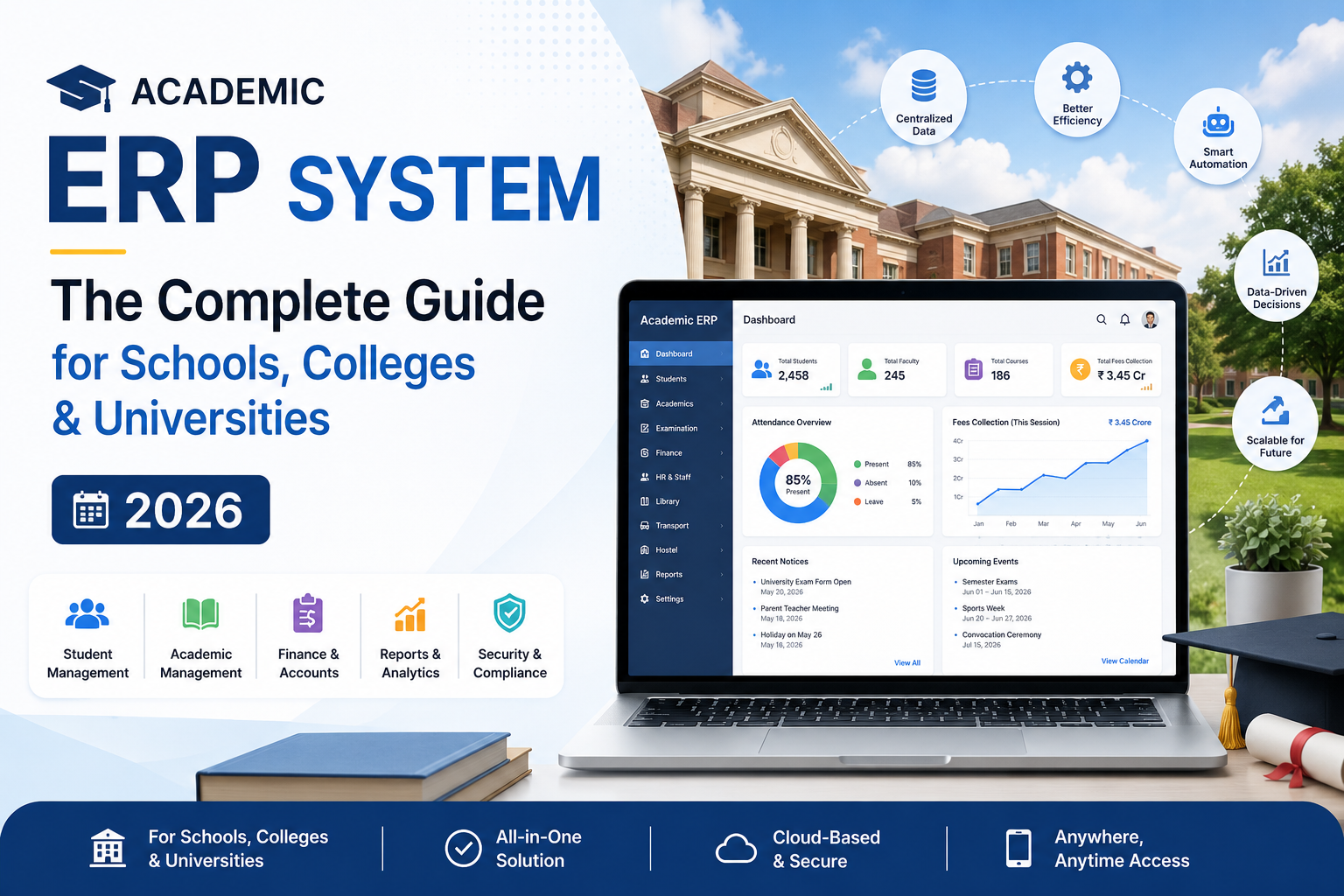
Academic ERP System those four words might sound a little cold and technical at first. But stick with me, because what they actually mean could change everything about how your institution runs, how your team feels at the end of the day, and how your students experience learning.
Let’s be honest: running a school, college, or university in 2026 is a lot. Admissions chaos, forgotten attendance sheets, parents chasing for grades, duplicate fee records, teachers buried in spreadsheets… sound familiar? You’re not alone.
In this guide, I’ll walk you through everything – no jargon, no sales pitch. Just real talk about what works, what doesn’t, and how to choose (or improve) an ERP that feels like it was actually made for your people. Ready? Let’s dive in
What Is an Academic ERP System?
An academic ERP system (Enterprise Resource Planning for education) is a unified software platform that connects the core administrative and academic functions of an educational institution into one system.
The key word is unified. Rather than running separate tools for admissions, fee management, exams, HR, and communication, an academic ERP brings them together so data moves automatically between departments without anyone re-entering it.
Think of it as the operating system for your institution: every department logs into the same platform, updates made in one area automatically reflect across others, and no information gets duplicated or lost.
This is fundamentally different from a basic school management app. A true academic ERP handles multi-department workflows. When a student enrolls, the admissions module, finance module, and academic records module all update simultaneously no manual handoff required.
The market reflects how urgently institutions need this: the global education ERP market was valued at approximately $15.9 billion in 2026 and is projected to reach $23 billion by 2032, according to Research and Markets. That growth is driven by institutions replacing fragmented, legacy systems with integrated platforms that support remote learning, data-driven decisions, and regulatory compliance.
A practical example: When a new student is admitted, the system automatically creates their fee account, generates their timetable based on enrolled courses, creates their attendance record, and triggers a welcome message to parents all without separate data entry in four different places.
Academic ERP vs. School Management Software: What's the Difference?
This question comes up constantly, and it matters for buying decisions.
| Feature | School Management App | Academic ERP System |
|---|---|---|
| Scope | Single school, single location | Multi-department, multi-campus |
| Data flow | Modules work independently | All modules share live data |
| Student lifecycle | Current enrollment only | Inquiry through alumni |
| HR & payroll | Teacher attendance only | All staff categories |
| Finance integration | Separate accounting tool | Integrated with academic data |
| Compliance reporting | Manual exports | Built-in, audit-ready |
| Scalability | Fixed for one school | Grows with the institution |
School management software typically handles operational tasks for a single school: attendance tracking, fee collection, timetables, and parent communication. It's designed for one-location use with a relatively simple administrative structure.
An academic ERP system is broader. It handles multi-department workflows where actions in one area automatically trigger actions in another, covers the full student lifecycle from inquiry through alumni engagement, manages HR and payroll for all staff categories, and produces compliance reports without manual data gathering.
For a primary school with one location and under 500 students, a school management app may genuinely be sufficient. For colleges, universities, language academies with multiple cohorts, or any institution growing toward complexity, an integrated academic management system is the right foundation.
Why Educational Institutions Need an Integrated Academic Management System
Most institutions don't suddenly collapse under poor administration. The decline is gradual small inefficiencies that compound quietly until they become visible problems.
Research published in the journal ERP Implementation and Adoption in Higher Education Institutions found that institutions using disconnected systems spend 40% more time on routine administrative tasks compared to those with integrated platforms. The same research documented a 47.3% reduction in financial processing time and a 68.2% decrease in data entry errors at institutions that successfully implemented ERP.
Here's what fragmented operations look like in practice:
Data fragmentation. Student grades live in a spreadsheet. Attendance sits in a separate tool. Fees are tracked in accounting software. HR is in another system entirely. No one has a complete picture of any individual student or the institution's health.
Manual re-entry. The same student data gets typed into three different systems, creating inconsistency and wasted hours. According to Academia ERP's research, administrators at institutions with disconnected systems juggle between five different software platforms just to process a single student enrollment a process that should take minutes but often stretches into hours or days.
Poor visibility for leadership. Principals and registrars can't see real-time performance data. Decisions lag behind reality because the data needed to make them takes days to compile.
Communication through unofficial channels. Notices reach students and parents via a mix of emails, WhatsApp groups, and paper circulars. Messages get missed. There's no record of what was sent or received.
Compliance preparation becomes a crisis. When accreditation is due, generating accurate reports requires days of manual data gathering from multiple sources, creating last-minute errors that put institutional standing at risk.
An academic ERP system eliminates these problems by design. When every function connects, information flows automatically and everyone works from the same data.
Core Modules: What a Complete Academic ERP Should Include
Not every institution will use every module from day one but they should all be available as the institution grows. Here's what a complete system covers:
1. Student Information Management (SIS)
The foundation of any academic ERP is a complete student information system: personal data, academic history, attendance records, assessment results, fee status, and behavioral notes all in one searchable profile, accessible to the right staff with the right permissions.
This single record follows the student throughout their time at the institution, creating a continuous history that supports everything from pastoral care to alumni engagement.
2. Admissions and Enrollment
Online application portals, document verification, interview scheduling, and automated offer letters. A well-designed admissions module reduces processing time from weeks to days and eliminates the back-and-forth email chains that slow the process down. For institutions managing large intake cycles, this module alone can save dozens of administrative hours per term.
3. Academic Planning and Curriculum Management
Course catalogue management, timetable generation, faculty assignment, and room scheduling. This is where the system functions directly as a platform for institutional academic planning documents every curriculum decision is documented, linked, and auditable rather than scattered across email threads and personal drives.
4. Fee and Finance Management
Fee schedule configuration, installment tracking, online payment integration, automated reminders, and financial reporting. Finance and admissions data link automatically so payment status is always current. The fee management capabilities of a proper academic ERP eliminate the need for a separate accounting tool for most institutions.
5. Assessment and Examinations
Exam scheduling, mark entry, automatic grade calculation, report card generation, and result publishing. An academic ERP functioning as an assessment management system for higher education significantly reduces manual exam administration. Research on ERP adoption in higher education institutions documents a 47.3% reduction in financial processing time after implementation exam workflows see comparable improvements.
6. Attendance Tracking
Biometric, RFID, or mobile-based attendance capture with real-time dashboards for class teachers. Managing attendance online with automatic parent alerts reduces the administrative load on reception staff and improves parent trust.
7. Staff and HR Management
Employee records, leave management, payroll processing, performance reviews, and professional development tracking. A complete system covers not just teaching staff but every employee administrative, support, and ancillary staff included.
8. Communication Tools
Structured communication channels — bulk SMS and email, push notifications, parent portals, and internal messaging — replace the ad-hoc WhatsApp groups and email chains that create confusion and missed messages. When communication runs through one platform, every message is logged and accountable.
9. Institutional Document Management
A centralized, searchable repository for accreditation documents, academic policies, meeting minutes, and strategic planning documents, with version control and role-based access permissions. This transforms the platform into a genuine knowledge management system for universities and colleges a place where institutional knowledge is preserved and accessible rather than siloed in individual inboxes.
10. Analytics and Reporting
Real-time dashboards covering enrollment trends, financial health, academic performance, and staff utilization. Export-ready reports for accreditation bodies, government compliance submissions, and board presentations without anyone spending a weekend compiling spreadsheets.
Thinking about moving to a platform that covers all of this? Clast.io brings every one of these modules together in a single system built specifically for education. Start free — no credit card needed →
Academic ERP for Colleges and Universities
The fundamentals of an academic ERP apply at every institution size, but colleges and universities face operational complexity that smaller schools simply don't. Understanding what changes at scale helps higher education leaders know exactly what to look for.
Multi-campus coordination. A university operating across multiple locations needs a system where each campus can manage its own operations while central administration maintains a consolidated view. This requires role-based access that respects campus autonomy while preventing data silos across locations. When evaluating a college ERP system, multi-campus support is not a feature to evaluate later it must work from day one.
Research and grants management. Universities need to track research projects, grant funding, researcher assignments, and deliverable timelines. Generic administrative ERP systems don't include this. Purpose-built academic ERP systems do connecting research activity with HR (faculty assignments) and finance (grant disbursements) automatically.
Complex fee structures. A community college or university manages tuition variations by program, international student pricing, scholarship offsets, Title IV financial aid (in the US), housing fees, lab fees, and installment payment plans simultaneously. The fee management module must handle this complexity without requiring custom development.
Accreditation documentation. Regional and programmatic accreditation bodies require institutions to produce evidence of learning outcomes, curriculum review processes, faculty qualifications, and institutional effectiveness on a regular cycle. A university-grade academic ERP should generate accreditation-ready evidence packages without manual document gathering.
Student retention analytics. Higher education institutions face significant pressure on completion rates. The higher education segment of the education ERP market is projected to grow at 18.4% CAGR through 2030 (Persistence Market Research, 2025), driven specifically by demand for AI-powered retention tools that identify at-risk students before they drop out.
Real Benefits
The benefits of a well-implemented academic ERP are real and documented. Here's what the research actually says:
Reduced administrative processing time. A study published on ResearchGate examining ERP implementation in higher education institutions found a 47.3% reduction in financial processing time and a 68.2% decrease in data entry errors at institutions that implemented integrated ERP systems. (Source: "A study on the impact of ERP implementation and Adoption in the Higher Education Institutions," ResearchGate, 2023.)
Less time lost to fragmented systems. Research from Academia ERP's ROI analysis found that institutions using disconnected systems spend 40% more time on routine administrative tasks than those with integrated platforms. This time cost compounds: multiply a two-hour enrollment process (versus 20 minutes with an ERP) by thousands of students per semester, and the accumulated cost becomes significant.
82% of higher education institutions upgrading core systems. Industry data cited by 360 Research Reports (2025) indicates that 82% of higher education institutions are currently upgrading their core administrative systems to support remote learning environments and data-driven decision-making reflecting how broadly the need for integrated management systems is recognized.
Cloud ERP adoption in higher education at 33% and accelerating. According to Info-Tech Research Group's 2025 analysis citing EDUCAUSE and ListEd Tech data, cloud ERP implementation in higher education reached 33% in 2024, up from historically low levels and on a trajectory similar to LMS cloud adoption, which went from 38% to over 90% in a decade.
Important caveats to set realistic expectations:
These benefits don't materialize automatically. Poor data migration, inadequate training, or resistance to changing established workflows can negate the gains. The institutions that achieve the research-documented outcomes are those that treat ERP implementation as an organizational change project, not just a technology deployment. The technology is the enabler the process change is the work.
Cost savings also accumulate over time, not immediately. Budget for a 12–18 month payback horizon rather than expecting cost neutrality in the first six months.
How to Choose the Right Academic ERP
This is where most buying decisions go wrong. Procurement teams evaluate features on a checklist and pick the vendor with the longest list. But features on a demo don't always translate into features that work in practice.
Test integration depth, not just feature lists
Every vendor claims their system does everything. The real question: does the admissions module actually feed student records automatically, or does staff still need to do a manual export? Does the fee system connect to the financial dashboard in real time, or is it a nightly sync?
The only way to know is to request a live demo using your institution's specific workflows not the vendor's scripted walkthrough.
Understand the deployment model
Cloud-based (SaaS) systems give you access from anywhere, automatic updates, and lower upfront cost. On-premise systems give you full data control but require your own IT infrastructure and maintenance. For most institutions in 2026, a cloud-based school ERP is the more practical choice but if your institution handles sensitive data under strict local data sovereignty laws, understand exactly where your data lives and how it's backed up before signing.
Check how configurable it actually is
Your institution has specific grading systems, fee structures, and report formats that won't match the system's defaults. Ask: how long does custom configuration take? Who does it the vendor, or your team? Can you make configuration changes yourself after go-live, or does every change require a support ticket?
Verify security and compliance credentials
Student data is sensitive and legally protected in most regions. Your platform must offer role-based access control, data encryption at rest and in transit, full audit logs, and compliance with the regulations that apply to you whether that's FERPA, GDPR, or local equivalents. Ask for documentation, not just verbal assurances.
Assess the support model realistically
Academic institutions operate on tight, non-negotiable timescales. Exam results, fee deadlines, and admission cycles don't wait for a support ticket to be resolved. Before signing, confirm the vendor's actual response time commitments and whether support is available outside business hours during peak periods.
Calculate the full cost of ownership
Headline pricing rarely tells the full story. Factor in implementation costs, data migration, staff training, and ongoing customization charges. A lower per-seat license with high implementation costs can end up significantly more expensive than a premium platform with guided onboarding included.
What Platforms Provide Institutional Academic Planning Documents?
This is one of the most common search queries reaching this blog, and it deserves a direct answer.
Institutions looking for platforms to handle academic planning documents need more than a file storage system. They need a platform that:
- Stores course catalogues, academic policies, accreditation submissions, strategic plans, and board documents in a single, searchable location
- Connects documents to live data so a course catalogue reflects current scheduling, faculty assignments, and enrollment figures automatically not a static PDF from last semester
- Controls who can view, edit, and approve each document type with role-based permissions
- Maintains a full version history so changes are tracked and previous versions are recoverable
- Makes generating compliance-ready reports straightforward, not a weekend-long manual project
The difference between document storage and a genuine academic planning platform is connectivity. A policy document that automatically links to the courses it governs which connect to faculty assignments, which connect to payroll is genuinely more useful than a PDF sitting in a shared drive that nobody updates.
Platforms that function as real academic planning document hubs treat documents as structured data rather than files. When you update a faculty assignment, the course catalogue and timetable reflect it. When accreditation is due, the evidence you need is already organized and current.
Common Implementation Failures and How to Avoid Them
ERP implementations in education have a documented failure rate. EDUCAUSE's 2024 report on administrative cost reduction notes that "culture eats strategy for breakfast" resistance to change is consistently the biggest barrier, not the technology. Understanding the common failure modes helps institutions plan more effectively.
Staff resistance is the most common obstacle
People who have used the same process for years even if it's slow and manual are reluctant to change. The solution is not to mandate the new system from the top and hope for compliance. Involve department heads early, run pilots with the most receptive teams first, and show concrete time savings with real data before rolling out broadly. Build internal champions in each department people who know the system well and can support their colleagues after go-live.
Data migration is harder than it looks
Moving years of student records, fee histories, and staff files into a new system is the most technically demanding part of any implementation. Vendors vary significantly in how much support they provide here. Audit your existing data thoroughly before migration starts incomplete or inconsistent legacy data becomes your problem once it's imported.
Training takes longer than planned
Budget for role-specific training before go-live. Generic sessions covering every module for every staff member rarely stick. Train admissions staff on the admissions module, finance staff on fee management, class teachers on attendance not everyone on everything at once.
Over-customization slows everything down
It's tempting to configure the new system to replicate your existing processes exactly. Resist this. Your existing processes were shaped by the limitations of your old tools. Implementation is an opportunity to improve workflows, not just digitize old ones. Accept the vendor's standard processes where they're reasonable save customization budget for the things that genuinely need to work differently for your institution.
Unrealistic timelines
Rushed implementations produce poor outcomes. ERP projects at educational institutions realistically take 3–6 months for a full rollout. Trying to compress that into six weeks to hit a semester deadline is a reliable way to create a system that staff distrust and avoid using.
AI and Trends Shaping Academic ERP in 2026
AI-powered early warning systems
The most meaningful use of AI in academic ERP right now is pattern recognition. Modern platforms use machine learning to identify students at risk of dropping out before the signs become obvious, flag unusual attendance patterns, and surface budget anomalies before they become problems. The higher education ERP segment's 18.4% CAGR is driven specifically by this demand for predictive retention tools.
Unified knowledge management
There is a clear shift from file-sharing to genuine knowledge management systems where documents are linked, searchable, connected to live data, and accessible to the right people at the right time. This is what separates a basic document store from a real knowledge management system for universities: the information is alive, not archived.
Mobile-first as a baseline expectation
Students, parents, and faculty now expect full mobile access not a simplified mobile view of a desktop system. Institutions find that ERP adoption rates are directly tied to how well the mobile experience works. A system that requires a desktop for key tasks loses users quickly.
Open API ecosystems
Very few institutions replace every system at once. Modern ERP platforms expose APIs that allow connection with existing tools library systems, learning management systems (LMS), identity providers, and third-party analytics so institutions integrate gradually rather than facing a disruptive full replacement.
Assessment evolving into outcome tracking
Assessment management systems for higher education are moving beyond exam scheduling and grade entry. The emerging standard is full learning outcome management: tracking whether students are achieving program-level outcomes, documenting the evidence for accreditation bodies, and identifying where curriculum gaps exist.
Cloud adoption accelerating
Cloud ERP implementation in higher education reached 33% in 2024, and the trajectory is clear: LMS cloud adoption went from 38% to over 90% in roughly a decade. ERP is on a similar path. Institutions still on legacy on-premise systems are increasingly finding that vendor support lifecycles are shortening, making the migration question not "if" but "when."
How Clast.io Fits Into This Picture
Clast.io is an all-in-one education management platform built specifically for schools, academies, colleges, and universities — covering academic delivery, institutional communication, task and workflow management, student and staff administration, assessments, attendance, and real-time performance analytics.
Unlike generic enterprise ERP systems adapted for education, Clast.io is built from the ground up for educational workflows. The terminology, report formats, and processes match how academic institutions actually operate.
What that looks like in practice:
- Student lifecycle management from inquiry through alumni, in a single connected record no separate systems to reconcile
- Fee management integrated directly with academic enrollment data, with automated payment reminders and real-time collection dashboards
- Attendance management with mobile capture, parent notification, and early-warning flags for at-risk students
- Assessment and exam management with automated grade calculation and report card generation
- Institutional document management for academic planning documents, policies, and accreditation records — with version control and role-based access
- Communication tools that replace unaccountable WhatsApp groups with logged, searchable channels
- Cloud-based deployment with role-based access control, data encryption, and GDPR-aligned data handling
Clast.io works for institutions at every stage from a single-campus school activating core modules, to a multi-location college managing complex academic programs. The modular structure means you start with what you need and expand as your institution grows.
Who Can Use an Academic ERP System?
Any educational institution with more than one department benefits from an integrated academic management system. The scale of implementation varies, but the underlying need is the same:
- Primary and secondary schools : attendance, timetables, fee collection, and parent communication in one place
- Colleges : admissions, course management, examinations, and hostel management
- Universities : faculty management, research tracking, multi-campus coordination, and accreditation reporting
- Language academies and training institutes : course scheduling, student progress tracking, and certification management
- Coaching centers : batch management, fee collection, and performance analytics
Smaller institutions often worry that ERP systems are built for large universities and won't fit their context. In practice, the best platforms are modular you start with the features you need today and activate more as you grow. There's no requirement to implement everything at once.
Conclusion
an Academic ERP System isn't about impressing anyone with fancy tech. It’s about making your days less chaotic, your team less stressed, and your students more supported.
You don’t need to flip a switch overnight. Start small. Pick one painful process admissions, attendance, fees and let a good ERP fix that first. Then build from there.
Because in 2026, no school or university should still be drowning in spreadsheets and WhatsApp chaos. You deserve better. Your staff deserves better. And honestly? The right ERP is just a tool that helps you give better without burning out.
Ready to take that first small step? Good. That’s all it takes.