
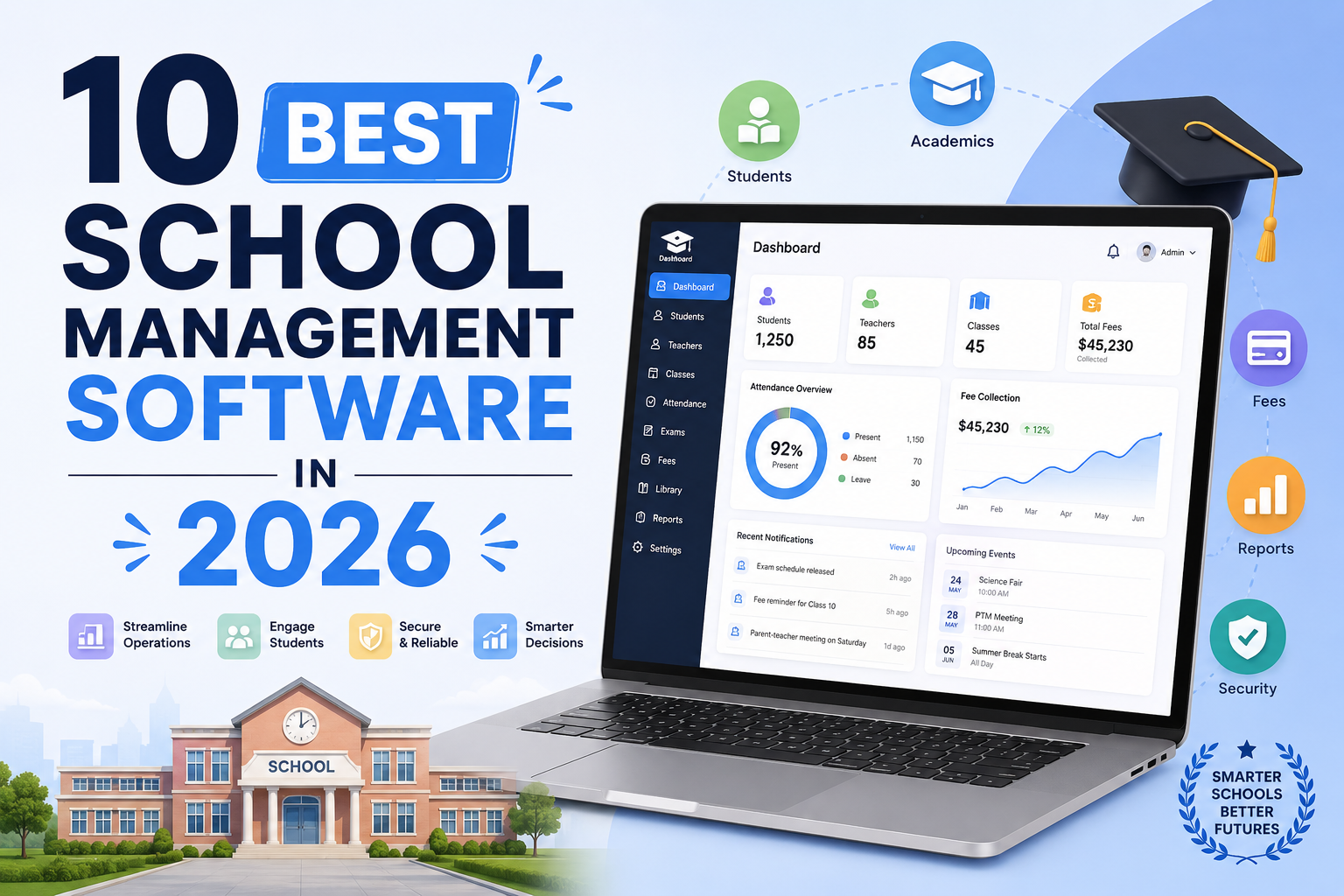
School management software (also called a school management system, school ERP, school administration software, or Student Information System) is a cloud platform that centralizes enrollment, attendance, gradebook, fee billing, staff records, and parent communication in one system. The best 2026 platforms add AI-powered early-warning alerts, open APIs, and mobile-first parent portals on top of these core functions.
Choosing the right school management software sometimes searched as software for school management, software for schools, or simply school software is one of the most important technology decisions an educational institution can make. The right platform eliminates administrative bottlenecks, connects every stakeholder, and gives you real-time visibility into what's happening across your school. The wrong one locks you into slow workflows, siloed data, and frustrated staff.
I've spent weeks analyzing the top platforms comparing real feature sets, verified user reviews, pricing structures, and fit across school types to give you a genuinely useful breakdown of the best options available in 2026. Every platform below was evaluated against the same seven criteria (see "How We Ranked These Platforms"), not picked because it advertises the most features.
What Is the Best School Management Software in 2026?
Here's a quick overview of all 10 platforms covered in this guide. Jump to any full review using the links below.
- Clast.io — Best all-in-one school management platform for schools, academies & colleges
- PowerSchool — Best for large K-12 public school districts
- Infinite Campus — Best for district-wide data integration
- Gradelink — Best for small private and faith-based schools
- Classter — Best modular platform for international schools
- Skyward — Best for combined student and business management
- Alma SIS — Best for PreK-12 Education Organizations of Every Size
- Classe365 — Best value for growing schools
- OpenEduCat — Best open-source option for technical teams
- Fedena — Best budget-friendly platform for emerging markets
How We Ranked These Platforms
Not every "best of" list uses transparent criteria. Here's exactly what we evaluated and why each factor matters.
Core feature depth: We assessed whether each platform genuinely covers the full administrative lifecycle enrollment, attendance, gradebook, scheduling, fee management, staff administration, parent portals, and reporting. Partial solutions didn't make the cut.
Ease of use for non-technical staff: Administrators and teachers aren't software engineers. A platform that demands weeks of training for basic tasks is a liability. We prioritized systems that real staff can navigate without a dedicated IT team constantly involved.
Integration capability: Schools run on ecosystems. We evaluated how well each SMS connects with Google Workspace, Microsoft 365, LMS platforms, payment gateways, and state-reporting portals. Siloed platforms scored lower regardless of individual feature richness.
Scalability: The right platform should still be the right platform in three years. We assessed whether each system can grow with an institution more students, more campuses, more complexity without requiring a complete replacement.
Support and onboarding quality: Features get you through the demo. Support gets you through the first year. We weighted implementation quality, training resources, and ongoing customer support heavily, especially for schools without dedicated IT departments.
Value for money: We considered total cost of ownership: licensing, implementation, training, and ongoing support. Expensive platforms can justify their price; we made sure they actually did.
Real user evidence: Every platform on this list has verifiable real-world usage at scale, cross-referenced through G2, Capterra, and peer institution references not just vendor-produced case studies.
A quick note on "AI-powered": Several platforms on this list, including our own, use "AI-powered" as a feature claim. That term means very different things depending on the vendor it can mean an early-warning alert that flags a student's attendance or grade trend before it becomes a crisis, an automated compliance-report generator, or a genuinely conversational assistant. Where we call out an AI feature below, we've described what it actually does, not just that it exists.
What Is School Management Software?
School management software (SMS) also referred to as a school ERP, school administration system, or Student Information System (SIS) is an integrated digital platform that centralizes the administrative, academic, and communication functions of an educational institution into one system. Institutions searching for school administration software, management software for schools, or a school database software to replace scattered spreadsheets are typically describing this same category.
A modern SMS typically unifies:
- Student Information System (SIS): Centralized records for every student enrollment, academic history, health data, and contact details.
- Attendance Management: Real-time tracking with automatic parent notifications for absences and late arrivals.
- Gradebook & Assessments: Flexible grading tools, standards-based assessment, and automated report card generation.
- Fee & Financial Management: Tuition billing, online payment processing, invoicing, and financial reporting.
- Parent & Student Portals: Real-time visibility into grades, attendance, homework, and school communications see our parent portal software guide for a deeper look at this category on its own.
- Staff & HR Management: Timetabling, leave tracking, staff records, and payroll integration this layer is sometimes searched separately as student administration software or staff-focused school operations software.
- Analytics & Reporting: Data dashboards surfacing student performance trends, attendance patterns, and compliance metrics.
The best platforms in 2026 go further embedding AI-powered early warning systems, open API connectivity, mobile-first interfaces, and workflow automation that eliminates repetitive manual tasks. For a broader look at how this category overlaps with (and differs from) general education management platforms, see our education management software guide, or our breakdown of SIS vs. ERP if you're trying to pin down exactly which type of system your school needs.
The 10 Best School Management Software Platforms in 2026
1. Clast.io Best All-in-One School Management Platform
Best for: Schools, language academies, colleges, and universities wanting one unified platform
Pricing: Starts from $0 (free tier available) see pricing
Website: clast.io
Clast.io is purpose-built as an AI-powered operating system for education. Unlike legacy platforms that were originally built for student record storage and later retrofitted with modern features, Clast.io was designed from day one to connect academic delivery, student administration, attendance, assessments, staff management, and real-time analytics in a single coherent platform.
What sets it apart from every other option on this list is the combination of depth and simplicity. Most institutions that migrate to Clast.io were previously managing five or six separate tools a gradebook here, an attendance tracker there, a communication platform somewhere else. Clast.io collapses all of that into one system without the complexity and cost overhead of enterprise-tier platforms.
It's also one of the only school management platforms on this list with a meaningful free tier, making professional-grade software for school management genuinely accessible to smaller schools and academies that can't justify enterprise pricing. Clast.io's platform is purpose-built to serve schools, colleges, and universities on the same core system for language institutes specifically, Clast.io also functions as a full academy management software, covering the same admissions, attendance, and billing workflows schools need.
Key features:
- Centralized student records and profile management
- Real-time attendance tracking with automated parent alerts
- Built-in assessments, grading, and performance analytics
- Institutional communication and task management
- AI-powered student progress monitoring (early-alert flags for grade and attendance trends before they become crises)
- Parent and student portals
- Workflow automation across administrative processes
- Staff administration and academic delivery tools
- Supports K-12 schools, higher education, and language institutes
What users say: Schools that implement Clast.io consistently highlight how quickly their admin teams adapted. The interface is clean enough that training time is minimal even for non-technical staff. And because everything lives in one platform, reporting that used to take hours now takes minutes.
Ideal for: Schools, academies, and colleges that want to eliminate tool sprawl and run every administrative and academic function from a single platform. Particularly strong for institutions with diverse student populations and multi-format program delivery.
Limitations: Clast.io is a newer platform compared to legacy giants like PowerSchool, so its ecosystem of third-party marketplace integrations is still growing though its core feature set covers the vast majority of what most schools actually need.
👉 Start for free at Clast.io | Book a Live Demo
2. PowerSchool Best for Large K-12 Public School Districts
Best for: Mid-to-large public school districts with dedicated IT staff
Pricing: Custom enterprise quote required
Website: powerschool.com
PowerSchool is the most widely deployed school management system in North American K-12 education. Its platform covers the full administrative lifecycle enrollment, attendance, grading, scheduling, analytics, and state reporting at a scale most competitors simply can't match.
For large districts managing thousands of students across multiple campuses while navigating state compliance requirements, PowerSchool remains the benchmark. Its reporting engine is deep, its integration library is extensive (including Schoology for LMS), and its parent and student portals are mature and reliable.
The trade-off is complexity. PowerSchool requires significant investment in implementation and staff training, and smaller schools often find it far more platform than they need.
Key features: District-wide SIS, state compliance and reporting automation, PowerSchool Schoology LMS integration, advanced analytics dashboards, extensive third-party integrations.
Implementation time: 3–6 months for large districts.
Limitations: High ongoing cost, steep learning curve, requires dedicated IT support.
Best for: Large public K-12 districts with the budget, IT resources, and compliance complexity to justify the investment.
3. Infinite Campus Best for District-Wide Data Integration
Best for: K-12 districts wanting a unified single-database administrative ecosystem
Pricing: Custom quote based on district size and modules
Website: infinitecampus.com
Infinite Campus is built on a single, unified database meaning every module (attendance, grades, scheduling, health, food service, finance) pulls from one real-time data source. There's no syncing lag between systems, no duplicate data entry, and no reconciliation headaches. When a student enrolls, every connected system updates immediately which is exactly what districts mean when they search for true school database software rather than a patchwork of linked tools.
For districts tired of managing separate vendors for every administrative function, Infinite Campus offers genuine consolidation. Its state-specific compliance tools and reporting engines also make it a consistent favorite with district administrators handling federal and state accountability requirements.
Key features: True single-database architecture, combined SIS, LMS, finance, HR, and food service, real-time data sync across all modules, monthly product updates, strong special education management tools.
Limitations: Interface is functional but shows its age in some modules; mobile experience is less polished than newer platforms.
Best for: US K-12 districts ready to consolidate multiple administrative systems into one tightly integrated platform.
4. Gradelink Best for Small Private & Faith-Based Schools
Best for: Small K-12 private schools and faith-based institutions
Pricing: Starts around $99–$299/month depending on enrollment
Website: gradelink.com
Gradelink is the platform most often recommended when a small private school is choosing its first serious SIS. It's affordable, fast to set up, and covers the core features that smaller institutions actually need attendance, gradebook, report cards, scheduling, parent communication without overwhelming staff with enterprise-grade complexity they'll never use. For faith-based institutions specifically searching for private christian school management software, Gradelink is consistently the most-recommended fit in its price range.
Gradelink is also known for having some of the best customer support in the school management software space US-based, responsive, and consistently praised in user reviews. For schools without a dedicated IT team, that matters enormously.
Key features: Comprehensive attendance tracking and reporting, report card and transcript generation, gradebook with flexible grading options, parent and student portal access, fully cloud-based, highly rated US-based support.
Limitations: Less suited to large or multi-campus institutions; limited advanced analytics compared to enterprise platforms.
Best for: Small K-12 private and faith-based schools looking for an affordable, reliable, and easy-to-deploy platform.
5. Classter Best Modular Platform for International Schools
Best for: International schools, independent institutions, and colleges wanting API-first flexibility
Pricing: Modular pricing from approximately €3/student/month
Website: classter.com
Classter is an all-in-one SMS/SIS/LMS platform with one of the strongest API integration stories on the market. Schools can connect it with virtually any third-party system payment gateways, LMS platforms, HR tools, custom-built alumni portals through clean, well-documented APIs.
Its modular pricing structure means institutions pay only for what they use and expand as they grow. The admissions CRM module is notably strong a capability many SIS platforms underserve despite its central importance to enrollment-driven schools.
Key features: Full SIS/LMS/CRM in one platform, strong admissions pipeline and enrollment CRM, API-first architecture, transportation and library modules, multilingual interface, GDPR-compliant data management.
Limitations: The breadth of available modules can be overwhelming during onboarding; best suited to schools with some technical capacity.
Best for: International schools and independent institutions that need a flexible, modular platform with strong integration capability.
6. Skyward Best for Combined Student & Business Management
Best for: K-12 districts wanting student management and back-office finance/HR unified
Pricing: Custom quote
Website: skyward.com
Skyward takes a different angle from most school management platforms. Rather than focusing purely on student records, Skyward integrates student management with back-office business administration payroll, HR, budgeting, and financial accounting sit alongside attendance, grading, and scheduling in one system. This dual focus is why Skyward comes up often in searches for school administration system and school operations software rather than just student-record tools.
For district administrators currently switching between a student system and a separate business system daily, Skyward eliminates that context-switching entirely. Its family engagement portal is also notably well-designed, giving parents granular visibility into academic progress, attendance, and behavior tracking.
Key features: Combined SIS and business ERP, payroll and HR integration, family portal with grades and behavior tracking, scheduling and course management, digital workflow and paperless tools.
Limitations: Interface is aging in some modules; third-party EdTech integrations are less extensive than PowerSchool.
Best for: Districts that want a single vendor covering both student information management and school business operations.
7. Alma SIS Best for Independent & Charter Schools
Best for: PreK-12 Education Organizations of Every Size
Pricing: Custom quote; generally competitive for smaller institutions Website: getalma.com
.Alma has earned a strong reputation in the charter school management software and independent school market by doing the essentials extremely well in a clean, modern interface. Enrollment, attendance, grading, scheduling, transcripts, and parent communication are all covered and new staff can navigate the platform within hours rather than after weeks of training.
Where Alma really differentiates is customer support. Independent schools often lack dedicated IT departments, and Alma's support team has earned consistently strong reviews for responsiveness and quality. Its built-in LMS integration also makes it a strong option for schools trying to connect administrative data directly with instructional delivery.
Key features: Modern, accessible interface, integrated gradebook and transcript generation, built-in LMS integration, parent and student portals, strong standards-based grading support, highly responsive support team.
Limitations: Less feature-complete in finance and HR compared to larger enterprise platforms.
Best for: Independent and charter schools that want a modern, full-featured platform without enterprise complexity or cost.
8. Classe365 Best Value for Growing Schools
Best for: Small to mid-size schools wanting comprehensive features at a competitive price
Pricing: From approximately $1/student/month; full-feature plans vary
Website: classe365.com
Classe365 packs a surprising amount of capability into an accessible price point SIS, LMS, CRM, admissions management, and billing making it an attractive student management software option for growing schools that need real depth without enterprise-tier costs. Its integrated CRM provides visibility into the prospective student pipeline that most platforms at this price point simply don't offer.
Key features: SIS, LMS, and CRM in one platform, built-in admissions pipeline management, online fee collection, mobile app, customizable reporting.
Limitations: Some advanced features are less mature than market leaders; customer support response times can vary on lower-tier plans.
Best for: Growing schools that need a feature-rich platform at a budget-friendly price, particularly those with active admissions operations.
9. OpenEduCat Best Open-Source Option
Best for: Tech-savvy institutions wanting open-source flexibility with no licensing fees
Pricing: Free community edition; enterprise edition pricing on request
Website: openeducat.org
Built on Python and the Odoo framework, OpenEduCat provides a free community edition with solid core functionality admissions, attendance, grades, timetabling, library plus a commercial enterprise edition with advanced features and dedicated support. For institutions with strong technical resources, the customization potential is exceptional.
Key features: Open-source codebase for full customization, integrated SIS/LMS/finance via Odoo, active global developer community, free core edition, enterprise support available.
Limitations: Requires real technical expertise to implement and maintain; not suitable for schools without in-house development capability; enterprise support costs can add up.
Best for: Institutions with technical teams who want the flexibility to customize every aspect of their platform and aren't willing to pay per-student licensing fees indefinitely.
10. Fedena Best Budget-Friendly Platform for Emerging Markets
Best for: Budget-conscious schools, particularly in Asia, Africa, and the Middle East
Pricing: Cloud plans from approximately $250/month; open-source edition available
Website: fedena.com
Originally open-source, Fedena now offers a commercial cloud edition with over 50 integrated modules covering student management, HR, library, transport, and examination management. Its affordability and functional breadth make it popular across emerging markets where budget constraints rule out enterprise platforms.
Key features: 50+ integrated modules, student and staff management, HR and payroll, library and transport management, exam scheduling, multi-language support.
Limitations: UI is dated; advanced analytics and AI features are limited compared to newer platforms; customer support quality can be inconsistent on lower-tier plans.
Best for: Budget-constrained schools in emerging markets that need a functional multi-module platform without the price tag of Western enterprise software.
Other Platforms You Might Be Comparing
If you're researching this category closely, you've likely also come across a handful of platforms that didn't make our top 10 but come up often in head-to-head comparisons:
- Edvance vs Classe365: Edvance is a smaller, newer entrant with a narrower feature set than Classe365's combined SIS/LMS/CRM. For most growing schools, Classe365's broader admissions and billing coverage makes it the stronger all-around choice; Edvance can be worth a look if you specifically want a lighter, simpler tool and don't need admissions CRM functionality.
- Praxischool vs Skyward: Praxischool is a lighter-weight SIS aimed at smaller schools; Skyward's combined SIS-plus-business-ERP depth makes it the better fit once a district needs payroll and financial accounting in the same system, not just student records.
- Dreamclass vs Classter: Both are modular, API-friendly platforms popular with international schools. Classter's stronger admissions CRM and broader third-party integration library generally give it an edge for institutions managing active enrollment pipelines; Dreamclass is a reasonable alternative for schools wanting a simpler, more streamlined module set.
- Sycamore Campus vs Gradelink: Both target small and mid-sized K-12 schools without enterprise pricing. Sycamore Campus is a solid, affordable option for transcript generation and enrollment management; Gradelink generally wins on customer support quality and speed of setup, which matters most for schools without in-house IT staff.
- FACTS Learning Platform vs Skyward: FACTS (often searched as "Facts Learning Platform") is well established in private and faith-based school administration, particularly for tuition management; Skyward's edge is in unifying student data with back-office finance and HR at the district level.
- Adminplus SIS: A student-records-focused SIS commonly evaluated by PK-12 private and faith-based schools; it covers the core administrative basics well but lacks the admissions CRM and LMS integration depth of platforms like Classter or Alma SIS.
- For large K-12 districts with enterprise-scale, high-compliance requirements: the honest answer is that PowerSchool and Infinite Campus remain the two platforms built specifically for that scale. Clast.io and Classter are worth evaluating if your "enterprise" requirement is really about multi-campus flexibility rather than state-level compliance reporting — the underlying needs are often different even when the RFP language sounds the same.
None of these six displaced a platform in our top 10 under the criteria in Section "How We Ranked These Platforms," but they're legitimate options worth a look depending on your specific must-haves.
Side-by-Side Comparison Table
| Platform | Best For | Starting Price | Free Plan | AI Features | Open API |
|---|---|---|---|---|---|
| Clast.io | All school types | $0/free tier | ✅ | ✅ Advanced | ✅ |
| PowerSchool | Large K-12 districts | Custom | ❌ | ✅ Advanced | ✅ |
| Infinite Campus | US K-12 districts | Custom | ❌ | ✅ Moderate | ✅ |
| Gradelink | Small private schools | ~$99/mo | ❌ | ⚠️ Basic | ✅ |
| Classter | International schools | ~€3/student/mo | ❌ | ✅ Moderate | ✅ Strong |
| Skyward | Districts (HR+finance) | Custom | ❌ | ⚠️ Limited | ✅ |
| Alma SIS | Independent/charter | Custom | ❌ | ✅ Moderate | ✅ |
| Classe365 | Growing schools | ~$1/student/mo | ❌ | ✅ Moderate | ✅ |
| OpenEduCat | Technical institutions | Free (OSS) | ✅ | ⚠️ Limited | ✅ Full |
| Fedena | Emerging markets | ~$250/mo | ❌ | ❌ | ⚠️ |
How to Choose the Right School Management Software
1. Map Your Biggest Administrative Pain Points First
Before looking at any platform, sit down with your team and list the five tasks that consume the most time or cause the most errors. Report card generation? Fee collection? Enrollment paperwork? Attendance tracking? Your SMS should solve your real problems first, not impress you in a demo with features you'll never use.
2. Define Non-Negotiables vs Nice to Haves
Create two lists. Non-negotiables are features the platform must have for example, Arabic language support, a specific state reporting integration, or biometric attendance. Nice-to-haves would improve operations but aren't dealbreakers. This discipline prevents sales demonstrations from dazzling you with irrelevant functionality.
3. Be Honest About Your Technical Capacity
Match platform complexity to your team's capabilities. A self-hosted, highly customizable platform like OpenEduCat is powerful but only if someone on your team can configure and maintain it. A cloud-first platform like Clast.io or Gradelink requires minimal IT overhead and can be running in days.
4. Pilot Before You Commit
Request a free trial or pilot for one department. Put real attendance data in. Generate a sample report card. Have three teachers use the gradebook. The issues you discover in a two-week pilot will save you years of frustration and potentially thousands of dollars. Clast.io's free tier is built specifically for this kind of no-risk evaluation start free and test it against your own data before talking to sales.
5. Evaluate the Vendor as Much as the Product
A school management system is a long-term relationship. Ask for references from schools your size, review the SLA documentation, understand the data migration plan, and ask where the product roadmap is heading in the next 12–18 months. A great product from a vendor with poor support is still a bad choice.
6. Calculate the True Total Cost of Ownership
The advertised per-student price rarely tells the full story. Factor in: implementation fees, data migration costs, staff training time, ongoing support tiers, and fees for modules you'll eventually need. A platform that looks cheaper upfront sometimes costs more over three years than a more expensive option with inclusive pricing this is exactly the gap that shows up when people search for the real school management system price, not just the headline number.
Conclusion
The school management software market in 2026 has more capable options than ever but that also means more decisions. The key isn't finding the most feature-rich platform. It's finding the right fit for your institution's size, budget, team capacity, and specific operational challenges.
For most schools that want to consolidate tools, simplify administration, and get real-time visibility without enterprise complexity, Clast.io offers the most compelling starting point, with a free tier that lets you evaluate it with zero risk before committing.
For large US public school districts with compliance-heavy environments, PowerSchool and Infinite Campus remain the benchmarks. For small private schools, Gradelink delivers proven simplicity and support. For international schools needing flexibility, Classter is hard to beat.
Whatever direction you go, invest time in the evaluation process. The platform you choose shapes how your entire institution operates day to day getting it right pays dividends for years.
Ready to see it in action? Book a free demo of Clast.io and get a walkthrough built around your school's actual admissions, attendance, and communication workflows not a generic feature tour.